
07.08.2026

Mark Novak
Author
Google Ads is the least forgiving major traffic source for gambling, and also the one where a compliant setup keeps running for years instead of weeks. There is no way to launch a casino or sportsbook campaign here without a certificate, a licensed destination, and a domain you actually own. Two policy changes landed in 2026 that tightened this further. New certification application forms went live on August 26, and from September 14 every account advertising in any gambling or games category must demonstrate what Google calls good policy health. This guide covers what is allowed, how certification works step by step, which GEOs are realistically worth targeting, and where beginners lose accounts.
Why Google Ads works differently from social traffic
On Facebook or TikTok, a gambling affiliate is buying interruption: the user was not looking for a casino, and the creative has to manufacture the intent. Google Search sells the opposite. Someone typing “best online casino bonus” or a specific brand name has already decided, and the ad only has to win the click. That intent gap is why cost per first deposit on Search can beat paid social even when the click price looks much higher.
The trade-off is that Google enforces at the account and domain level rather than at the creative level. A rejected creative on Meta costs one creative. A revoked gambling certificate on Google can cost the account, and under the rules taking effect in September 2026, repeated revocations inside a manager account can make the whole MCC ineligible for new gambling certificates. The economics reward patience and a clean setup, not volume testing.
Which gambling verticals are allowed
Google splits this space into several distinct categories, and they are not interchangeable. Knowing which one you are in determines which application form you file and what your site has to show.
- Online gambling (operators). Real-money casino, sportsbook, poker, bingo, and lottery products run by a licensed operator. Requires certification in every country you target.
- Gambling-promoting content (affiliates and aggregators). Review sites, comparison pages, and bonus aggregators that send traffic to operators. This is the category most affiliates fall into. You do not need to hold a gambling license yourself, but you must link exclusively to operators licensed in the region you are targeting.
- Online non-casino games. Skill-based and fantasy formats. Certification is required in some jurisdictions and not others, which makes this category the most country-dependent of the group.
- Social casino games. Free-to-play casino-style games with no real-money payout. A separate application form, a separate allowed-country list, and a hard structural rule: one Google Ads account cannot hold both an online gambling certificate and a social casino certificate.
- Prediction markets. Handled under their own repeatedly-updated policy rather than the general gambling rules, so check the current article before planning anything here.
Sweepstakes casinos were removed from the permitted set in late 2025 and are not a viable Google Ads vertical.
Google Ads gambling certification step by step
Certification is a document exercise, not a growth hack. Most rejections come from an incomplete application rather than from an unsuitable business.
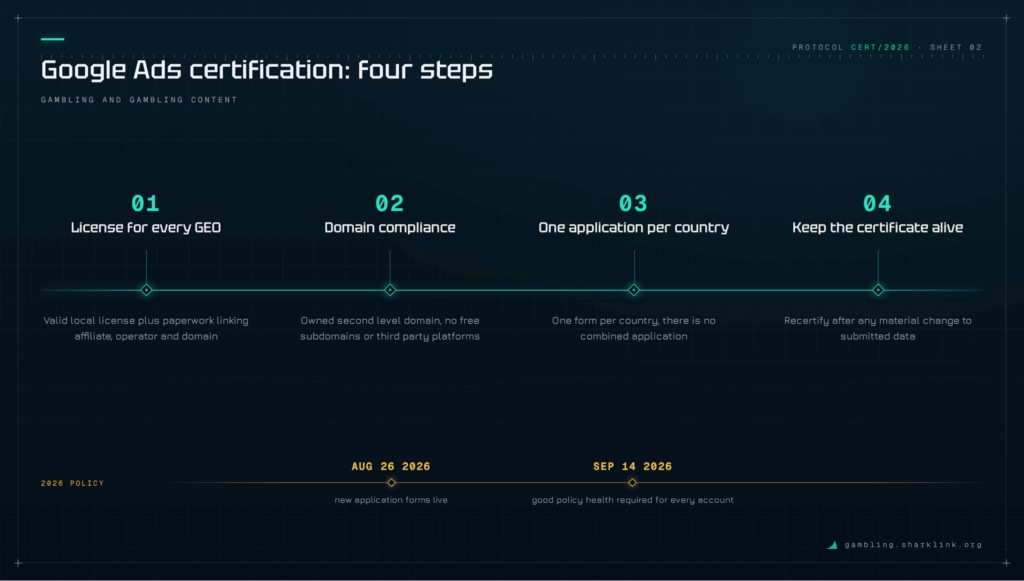
Step 1: Confirm the destination is licensed
For every country you intend to target, there must be a valid local license, and you must be able to evidence it. Affiliates face an extra step here. If the relationship between your entity and the operator is not obvious from the paperwork, Google expects documentation spelling out the link between the advertising entity, the gambling entity, and the domain.
Step 2: Bring the domain into compliance
Fix the site before you apply, not after a rejection. Free subdomains are ineligible. Sub-domains sitting under a third-party platform host are ineligible. The second-level domain has to be owned and operated by you. A domain with no connection to gambling will not be certified for gambling.
Step 3: File one application per country
Submit the online gambling application form for operators and gambling-promoting content, or the social casino games application for that category. Targeting three countries means three separate applications. There is no combined form.
Step 4: Keep the certificate alive
Any material change to what you submitted triggers a recertification obligation. Ignoring that can lead to account suspension rather than a warning. Treat a corporate restructure, a domain migration, or a change in which operators you link to as a recertification event.
Landing page and domain requirements
The destination page carries most of the compliance weight, and reviewers check it directly.
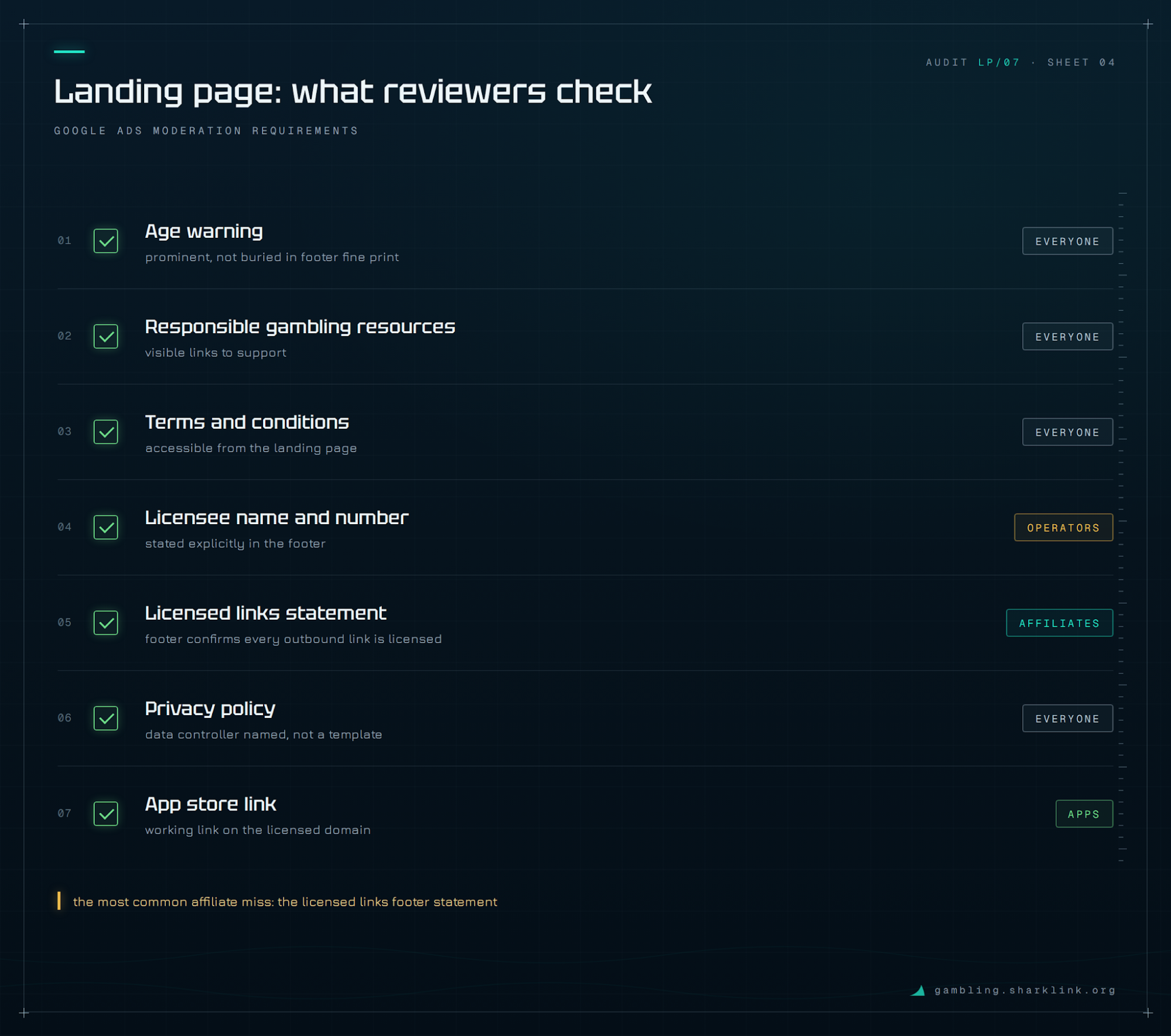
| Requirement | Applies to | What reviewers look for
|
|---|---|---|
| Age warning | Everyone | Prominent, not buried in the footer fine print |
| Responsible gambling resources | Everyone | Visible links to addiction support |
| Terms and conditions | Everyone | Accessible from the landing page |
| Licensee name and license number | Operators | Stated explicitly in the footer |
| Licensed-links statement | Affiliates | Footer statement confirming all outbound links go only to operators licensed in the target region |
| Privacy policy naming the data controller | Everyone | Data controller identified, not a generic template |
| App store link | App promotion | Working link on the licensed domain, plus a link back to the registered domain from the store listing |
For affiliates the licensed-links statement is the item most often missing. It is not enough to link to licensed brands; the footer has to say so.
Which GEOs work best for gambling on Google Ads
Google permits gambling ads in roughly 55 countries, but permitted and profitable are different questions. The markets that reward Google Ads spend share three traits: a clear national licensing regime, a search-literate audience, and operators willing to pay competitive revenue share because their own acquisition costs are high.
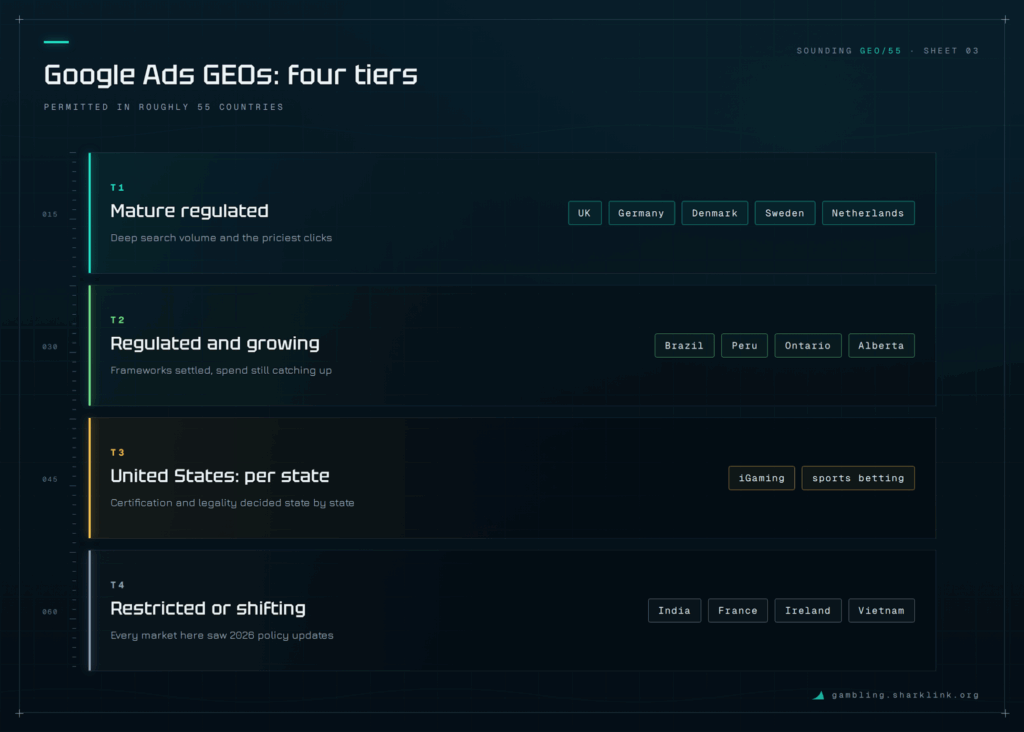
| Tier | Markets | Why it works | Watch out for
|
|---|---|---|---|
| Mature regulated | UK, Germany, Denmark, Sweden, Netherlands | Deep search volume, high player value, unambiguous licensing | Highest CPCs and the most sophisticated competition |
| Regulated and growing | Brazil, Peru, Ontario and Alberta in Canada | Licensing frameworks now settled, spend still catching up to demand | Rules changed recently, so verify current status per market |
| State-by-state | United States | Very high player value in live states | Certification and legality are per state, not per country |
| Restricted or shifting | India, France, Ireland, Vietnam | Real volume where permitted | Each of these saw policy updates during 2026; check before budgeting |
The practical filter for a new affiliate is narrower than the permitted list suggests. Pick one market where you can name the regulator, the license type your partner operators hold, and the local responsible-gambling requirements without looking them up. If you cannot do that, you are not ready to apply for that country.
Advantages and disadvantages of Google Ads for gambling
Advantages. Search intent is already there, so conversion rates from click to registration usually beat interruption-based channels. Traffic is stable once certified, without the account-churn cycle familiar from paid social. Attribution is comparatively clean, which makes the tracker data actually usable for optimization. Brand and bonus queries can be captured at the exact decision moment. And a compliant setup compounds: the longer an account runs cleanly, the more policy health it accumulates, which matters more under the 2026 rules than it did before.
Disadvantages. The entry barrier is real, both in paperwork and in time to first impression. Cost per click in mature markets is high, and you are bidding against operators with much larger budgets and in-house teams. Every new country needs its own application. Policy shifts frequently, with dozens of gambling-specific updates logged in 2026 alone, so a setup that was compliant in January may not be in September. And enforcement is account-level, meaning one serious mistake costs more than a rejected ad.
Recommendations for beginners
- Start with one GEO and one operator partner. Multi-country ambitions before the first certificate is approved just multiply the ways an application can fail.
- Budget for the waiting period. The gap between deciding to run Google Ads and serving the first impression is measured in weeks, not hours, and that time still costs money.
- Build the compliant landing page first. A site that already carries the age warning, responsible gambling links, the licensed-links footer statement, and a proper privacy policy converts a rejection risk into a formality.
- Use a separate account per certification type. Social casino and online gambling cannot coexist in one account, and discovering this after building out campaigns is an expensive lesson.
- Start on brand and high-intent keywords rather than broad category terms. Broad gambling keywords in mature markets are where beginner budgets disappear fastest.
- Track from click to deposit, not click to registration. Google’s optimization only becomes useful when the conversion you feed it is the one that pays.
- Read the policy change log monthly. Gambling policy on Google Ads moves more than almost any other vertical, and the change log is the only reliable place to see what shifted.
Common reasons for rejection and suspension
The pattern behind most failed applications is administrative rather than commercial. A domain on a free platform or a third-party subdomain fails automatically. A missing footer statement on an affiliate site fails even when every linked operator is genuinely licensed. Licensing evidence that does not clearly connect the advertising entity, the gambling entity, and the domain gets returned. Targeting a country you did not separately apply for produces disapprovals that look like a technical bug but are not.
Post-approval, the biggest avoidable loss is failing to recertify after a material change. The second is accumulating policy violations under a manager account: from September 2026, repeated flags across accounts inside one MCC can cost the whole structure its eligibility for new gambling certificates.
Glossary
- Certification: the per-country approval from Google that allows an account to run gambling or gambling-promoting ads.
- Gambling-promoting content: Google’s term for affiliate and aggregator sites that send traffic to gambling operators without being operators themselves.
- Policy health: the compliance record of a Google Ads account, which from September 2026 gates eligibility to apply for or renew gambling certificates.
- MCC (manager account): an umbrella Google Ads account managing multiple sub-accounts, now also a unit of shared compliance risk in gambling.
- Recertification: the required re-application after any material change to the information in an approved certification.
- Data controller: the entity legally responsible for user data, which must be identified by name in the destination site’s privacy policy.
FAQ
Can an affiliate run Google Ads for gambling without holding a gambling license?
Yes. Affiliates fall under gambling-promoting content, which does not require you to be a licensee. The condition is that every outbound gambling link on the advertised domain goes to an operator licensed and authorized in the region you are targeting, and that your footer states this explicitly.
How long does Google Ads gambling certification take?
Google does not publish a guaranteed turnaround, and the practical answer depends on how complete the application is. Applications with clear licensing evidence and a compliant destination site move faster than ones that trigger a follow-up request, which is the main argument for fixing the site before applying rather than after.
Do I need a new certificate for each country?
Yes. There is one application per country, with no combined form. This is a common cause of unexpected disapprovals when someone expands targeting on an already-certified account.
Can one account run both social casino and real-money gambling ads?
No. A single Google Ads account cannot hold both an online gambling certification and a social casino games certification. Separate accounts are required, and the same restriction applies across different social casino targeting groups.
What happens if my business details change after certification?
You are required to recertify immediately after any material change to the information you submitted. Skipping this can result in suspension rather than a warning, so treat domain moves, entity changes, and shifts in linked operators as triggers.
Is Google Ads worth it for a beginner affiliate compared with Facebook?
It depends on the tolerance for setup time versus account risk. Facebook lets you test tomorrow and may ban the account next week. Google takes weeks to start and then runs stably if the setup is clean. For an affiliate with one licensed partner and a real site, Google is usually the better long-term base; for someone testing offers rapidly with no site, it is not the right first channel.
Summary
Google Ads rewards affiliates who treat gambling as a licensed business rather than a traffic experiment. The 2026 changes push further in that direction: good policy health as an eligibility gate, stricter domain ownership rules, a footer statement affiliates cannot skip, and shared risk across manager accounts. None of that is prohibitive, but all of it has to be in place before the first impression rather than after the first rejection. Start with one regulated GEO, one licensed partner, and a destination site that already meets every requirement in the table above. Once the compliance side is settled, the remaining question is which operator to send that traffic to: SharkLink’s affiliate program catalog collects gambling and betting partnerka reviews with real payout terms, GEO requirements, and NGR formulas.
Mark Novak
Author
Similar articles by the author



Leave a comment
Thank you for your feedback!
Your review will be published after moderation.