
Virtual cards
Services for creating virtual bank cards for arbitrageurs and paying for advertising on Google Ads, Facebook Ads, TikTok Ads, and other foreign services. Here you will find the best foreign cards with American and European BINs.
Currency
3DS support
KYC verification
Other
- Alphabetical order
- By date


How to use virtual cards in affiliate marketing?
A personal bank card rarely survives a second month of media buying: one charge clears, the next one bounces, and the ad account goes under review with the budget still sitting on it. Virtual cards for affiliate marketing fix that at the infrastructure level, because every ad account gets a number of its own. Below is how a BIN works, what the fee stack really contains, and which criteria teams use when picking a provider for their GEOs.
What virtual cards for affiliate marketing actually are
A virtual card exists as credentials only: number, expiry date and CVV land in the provider dashboard within seconds. Nothing ships in plastic, and the number attaches to any ad platform that accepts online payments. The working rule across the market is blunt: one ad account, one card.
Personal bank cards break for a structural reason. Payment systems score the issuing country, product type, billing data and decline history, then stop letting charges through altogether. One blocked payment drags the ad account into review, and the money sits frozen indefinitely.
Giving each cabinet its own number keeps the damage inside a single account. A complaint or a decline stays where it happened instead of rippling across other campaigns, since processing no longer links them. A pool-wide outage becomes a one-number repair.
There is a bookkeeping upside too: every number carries its own transaction history, so spend per campaign is readable without manual reconciliation. Limits map to the daily budget and whatever goes unspent returns to the provider balance. A burnt cabinet stops taking the team treasury down with it.
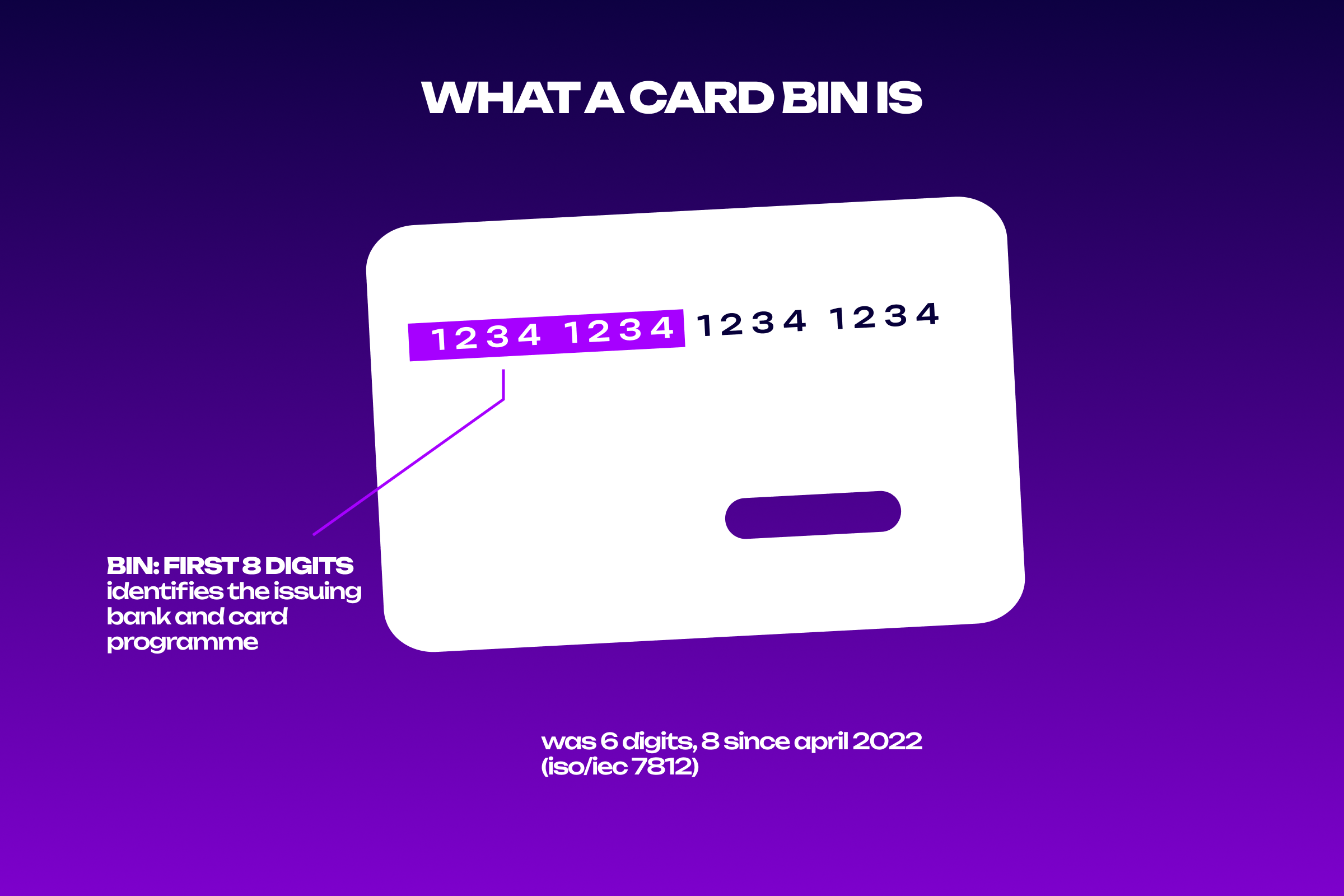
BIN: the part of virtual cards that decides everything
BIN stands for bank identification number and occupies the first six digits of the card. The April 2022 change to ISO/IEC 7812 stretched that field to eight. Processing reads the string to establish which bank issued the number and which card programme it belongs to.
Public BINs go out to tens of thousands of users at once. Chargebacks filed by strangers on the same range degrade the BIN for everybody on it, yourself included. Nothing went wrong on your side, yet the charge still fails.
Coverage varies wildly: some providers run on a single BIN, others hold over one hundred. Wider coverage lets you match a number to a specific ad platform instead of stacking every cabinet onto one range.
- How many BINs sit in the pool. A single range puts every client of that provider behind identical first eight digits, so one wave of complaints hits all of them together. With a hundred ranges you swap a degraded number for a neighbour and the campaign never pauses.
- Whether the BIN is public or private. Public ranges are open to anyone who signs up, private ones stay locked to a limited set of users. Private costs more, though its decline history gets written by a handful of teams rather than by random strangers online.
- How the range behaves per platform. Some BINs clear consistently in one ad system and fall over just as consistently in another. Only a test charge settles it, because a result another team got on a different GEO will not transfer to your case.
Fees and payment formats of virtual cards for affiliate marketing
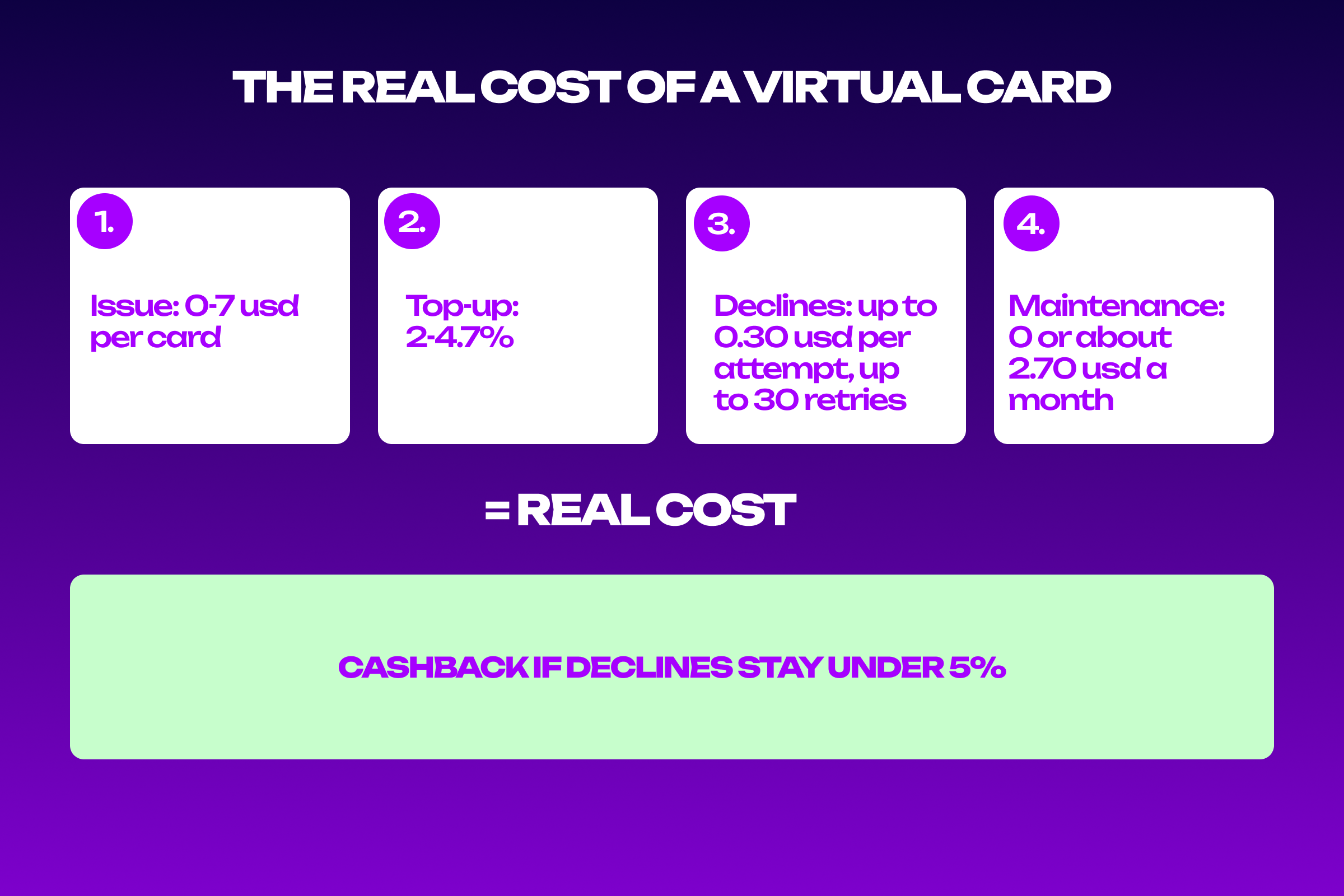
A provider price list rarely fits on one line. Four items take money at minimum: issuing the number, topping up the balance, failed charges and monthly maintenance. Comparing providers on the top-up percentage alone leaves most of the spend out of frame.
| Cost item | What it is charged for | Typical range | What it affects |
|---|---|---|---|
| Card issue | Every new number created | 0 to 7 USD | How many numbers a team keeps for testing |
| Top-up | Percentage of the credited amount | 2% to 4.7% | Real cost of media buying at volume |
| Declined charge | Each unsuccessful attempt | 0 to 0.30 USD | Price of a retry series on one number |
| Maintenance | Each active number, monthly | Absent or about 2.70 USD | Cost of idle numbers nobody spends on |
| Cashback | Paid on turnover while the decline share stays under 5% | Set by the provider, confirm with a manager | Effective rate after every deduction |
Issuing a card runs from zero to 7 USD. Certain providers hand over the first 50 numbers free and charge roughly 2 USD each after that, a visible line in month one for teams spinning up cabinets by the dozen.
Top-up commission sits between 2% and 4.7%, and several providers price it separately for each advertising platform. Read the rate for the platform carrying your main volume, not the headline figure on the landing page. Terms for individual companies are collected in the payment providers catalogue.
Declines are the most underrated line of all. Processing retries a failed charge up to thirty times, each attempt costs as much as 0.30 USD, and the total reaches 15 USD on a single number. Maintenance is either absent or around 2.70 USD per number, while some providers pay cashback instead for as long as the decline share holds under 5%.
GEO, currency and localisation of virtual cards
The same card behaves differently across GEOs. An ad platform cross-checks the issuing country against the cabinet country, account currency and billing data, and any mismatch raises the odds of a manual review.
Currency is the second classic leak. When the card runs in one currency and the cabinet in another, the payment system converts at its own rate, so the actual top-up cost drifts from the price list figure.
| Parameter | What it changes | What breaks without it |
|---|---|---|
| Card issuing country | How the payment system scores the transaction | The charge is refused before the cabinet sees it |
| Card currency against ad account currency | Conversion rate and real top-up price | Spend drifts from the price list every transaction |
| Local top-up method availability | How money reaches the provider balance at all | No way to fund the balance, so campaigns stall |
| Billing address requirements | Whether address verification clears at charge time | Payment goes to manual review and the profile gets flagged |
| Restricted regions | GEOs where the number is not serviced at all | Number is dead on your target market with no warning |
Run a minimum test charge before entering a new GEO. Learning that a range is refused by local processing costs one dollar, whereas learning it mid-campaign costs the whole budget line.
Verification, KYC and 3DS on virtual cards
Documents come before the first number is issued: passport or ID, sometimes a selfie, sometimes proof of address. How deep the check runs depends on the issuer jurisdiction, and clearing it upfront beats unfreezing an account with a balance stuck inside.
A mismatch between card data and ad account data reads as a direct signal to the risk team. Cardholder name, country, address and phone need to match what the cabinet holds, or the payment gets pulled for manual handling and the profile picks up a flag.
Merchants running strict verification require 3DS support, and without it the payment will not go through at all. Most failures here come from a closed confirmation window or an IP change between sessions rather than from the card. Keep one identity end to end: same profile, same country, same connection at every stage.
Common mistakes with virtual cards for affiliate marketing
Most losses here trace back to team habits rather than the provider. One number across several cabinets, an ignored decline share and a decision made on one percentage keep repeating from project to project.
- One card across several ad accounts. A block on one cabinet pulls the rest in, because processing already treats them as linked through the shared number.
- Ignoring the decline share. Processing retries a failed charge up to thirty times, and the fees for those attempts reach 15 USD on a single number.
- Paying for ads with a personal bank card. Payment systems score the issuing country, product type and decline history, then stop letting charges through.
- Picking a provider on the top-up percentage alone. Issue fees, maintenance and declines add a sum to the total that the advertised rate never shows.
Teams arrive asking about the top-up percentage and lose money on declines nobody bothers to count. Price out thirty failed attempts on one card and the tariff question answers itself.
How to choose a virtual card provider for affiliate marketing
The decision starts with where the budget goes, not with the tariff. A perfect price list is useless if the provider BIN does not clear in your ad system, so a minimum test top-up comes first.
Support quality is the second filter: response speed, and what the provider does when declines arrive in a wave. Comparing terms across companies is easier through the services catalogue, though live traffic delivers the final verdict.
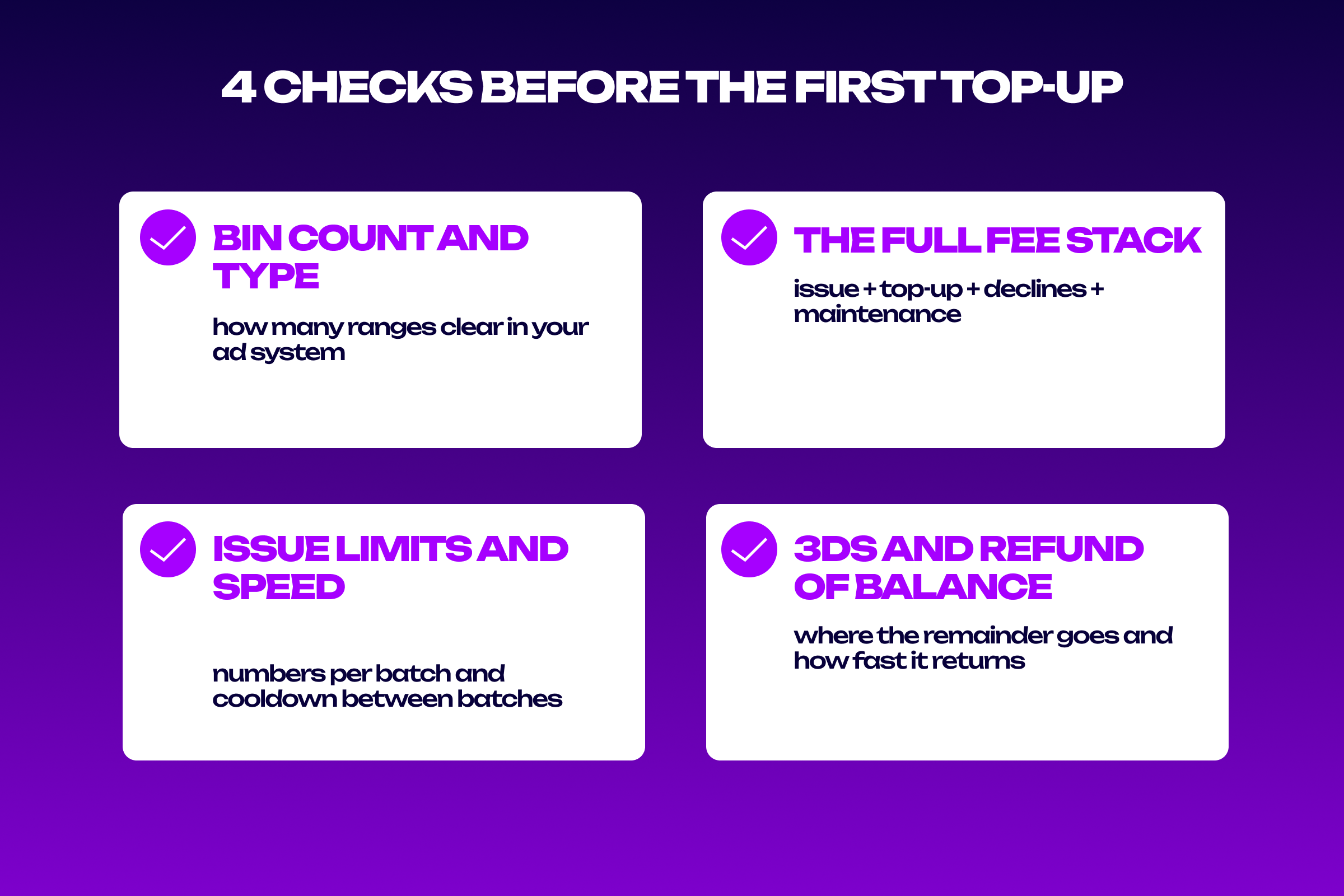
- BIN count and BIN type. Ask how many ranges clear in your specific ad system, not the headline number from the marketing page.
- The full fee stack. Issue, top-up, decline, maintenance and cashback get counted together, or a cheap-looking tariff turns out to be the expensive one.
- Issue limits and issue speed. How many numbers come out per batch, and whether a cooldown sits between batches, matters for teams launching cabinets daily.
- 3DS support and refund behaviour. Where the remainder from a disabled cabinet goes, and how long it takes to land back on the balance.
FAQ on virtual cards for affiliate marketing
How many cards does one ad account need?
One. The working rule reads exactly like that: one account, one card. A shared number ties cabinets together in processing, so a block on one drags the others into review.
How does a private BIN differ from a public one?
A public range serves tens of thousands of users at once, and chargebacks filed by strangers degrade it for everyone. Private ranges stay with a narrower group, which makes the decline history far more predictable. The price is higher, and so is the lifespan.
Why not pay for ads with a personal card?
Payment systems score the issuing country, product type, billing data and decline history. Once the profile lands in the risk zone, charges stop clearing and the cabinet goes under review.
What should I do when 3DS fails?
Check the session before you blame the card: most failures trace to a closed confirmation window or an IP change between visits. Retry the payment from the same profile on the same connection and the code usually arrives.
How much does maintaining a virtual card cost?
The monthly fee is either absent or roughly 2.70 USD per number. Issuing runs from zero to 7 USD, with the first 50 free at some providers and roughly 2 USD apiece beyond that.
Bottom line on virtual cards for affiliate marketing
Virtual cards for affiliate marketing solve for keeping the cabinet and its budget alive, not for shaving costs. One account with one card, plus a BIN that clears in the ad system you spend on, buys more stability than chasing the lowest percentage on a price page.
Count every line at once: issue from zero to 7 USD, top-up from 2% to 4.7%, declines up to 0.30 USD per attempt and maintenance near 2.70 USD per number. Add the cashback paid while the decline share stays under 5%, and the picture turns honest. A test charge before entering a new GEO still costs less than any audit.