
Application rental
Mobile application rental services focused on the betting and gambling market, supporting various operating systems and modern web technologies.
Operating system
Work status
- Alphabetical order
- By date


App rental in affiliate marketing – how does it work?
An application rental deal buys one thing a landing page never will: a permanent icon on the player’s home screen and a push channel that keeps firing after the ad account goes quiet. You rent a published build, point paid traffic at the install link and settle up per install. Entry pricing opens at 0.05 USD per install on cheap tiers. What follows covers the PWA and native split, four billing models, store rules and the numbers worth checking first.
What application rental actually buys you
Stores are the reason this market exists. Across 2025 the open mobile platform kept 1.75 million policy-breaking apps out of its catalogue and shut over 80,000 developer accounts, while the closed ecosystem rejected more than 2 million submissions.
The mechanics are plain. A vendor keeps a pool of approved builds and hands partners an install link; the player taps it, gets an icon and lands on your offer inside the shell. Pull one build and the next arrives.
Doing it in-house fails on timing rather than money. A developer account costs 25 USD once on the open store and 99 USD a year in the closed ecosystem. A fresh personal account must clear closed testing though: 12 testers, opted in continuously for 14 days.
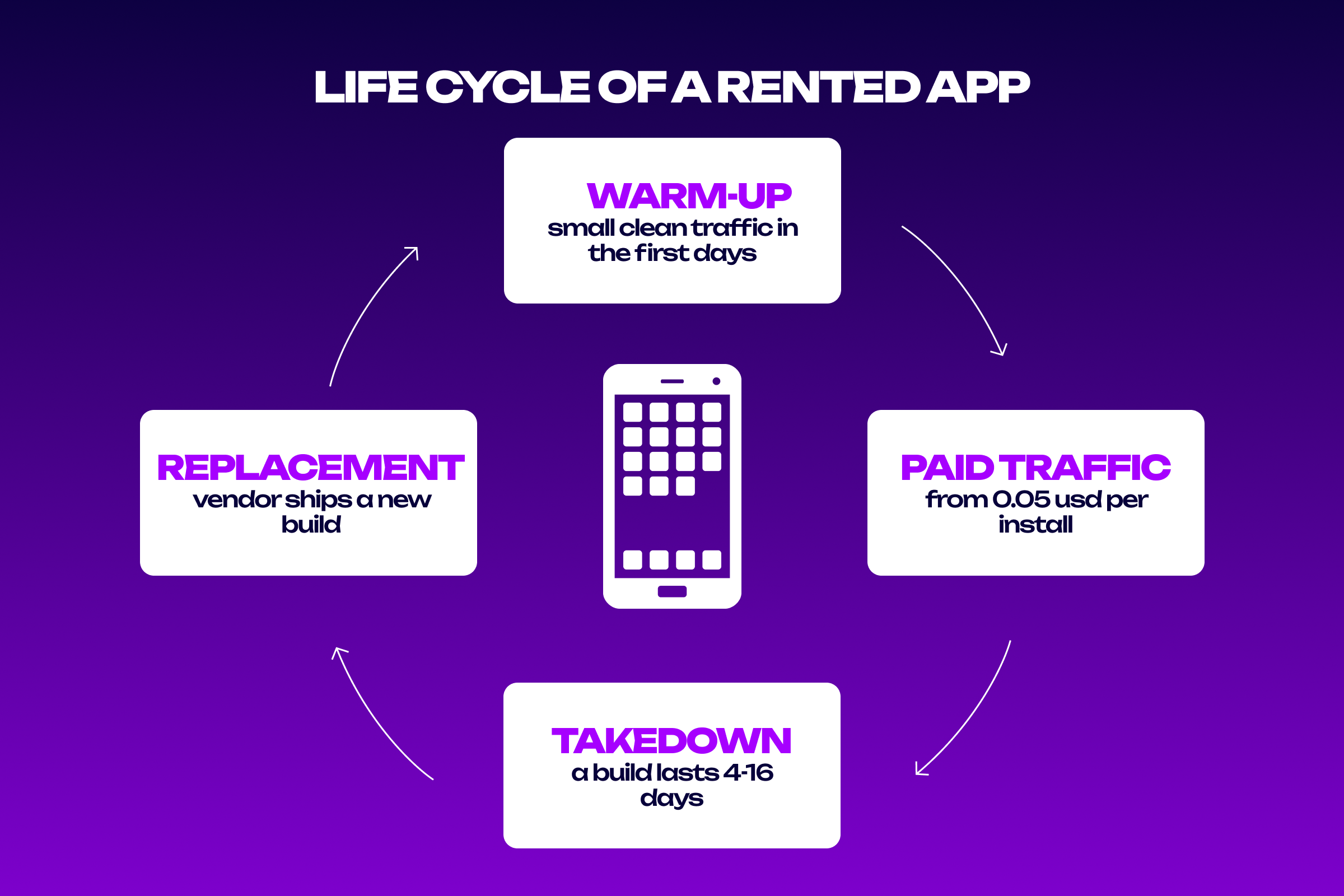
Then there is shelf life. Teams running grey gambling builds report 4 to 16 days before removal, and a web shell rarely survives past three weeks. Application rental moves that attrition onto the vendor.
PWA builds and native shells
Both formats end up as an icon, yet they answer to different masters. A PWA sits on your own domain and no store gets a vote. A native shell lives in a public catalogue, where one complaint ends it inside an hour.
Installability rules for a PWA are public and short. Serve over HTTPS, ship a manifest with start_url and display, and include a 192 px and a 512 px icon, or the browser never offers the prompt. Web push on the closed mobile OS needs version 16.4 and fires only after the user adds the app to the home screen.
Native builds trade freedom for reach. Review in the closed ecosystem clears 90% of submissions in under 24 hours, so swap cycles run shorter than buyers expect. That access shows in the rental rate card.
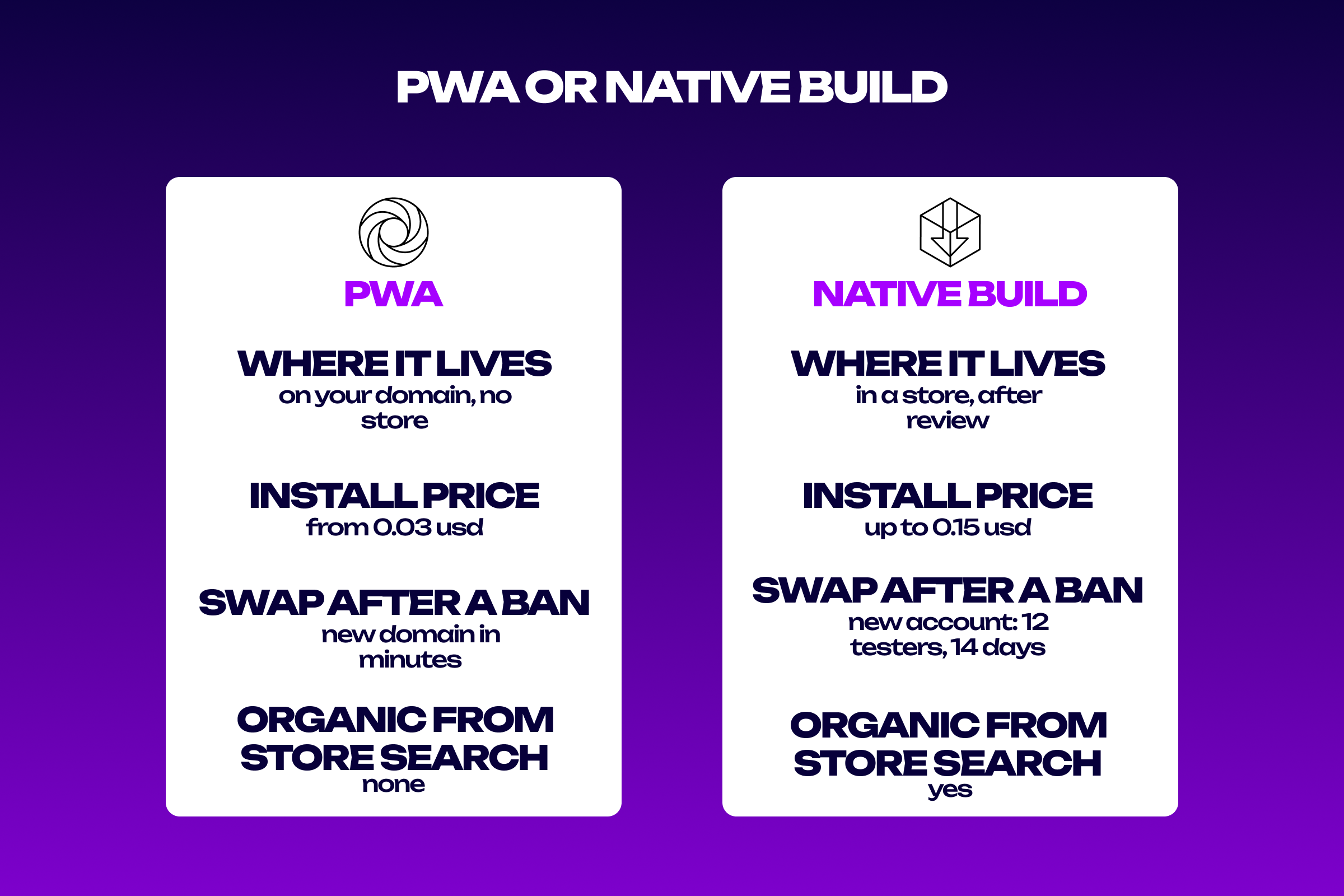
- A PWA answers to nobody: swap the domain after a ban and the build is live again in minutes, no developer account required, with installs priced from 0.03 USD at some vendors. The trade-off is zero organic pickup from store search.
- Native shells cost more and demand patience: installs reach 0.15 USD on the closed platform, and a new personal account on the open store unlocks production only after 12 testers stay opted in for 14 straight days.
- Hybrid setups route paid traffic to a store listing and push incompatible devices onto a PWA fallback. Vendors bill those links separately in rental, from 3 to 6 USD per generated domain on top of the per-install rate.
How application rental is priced
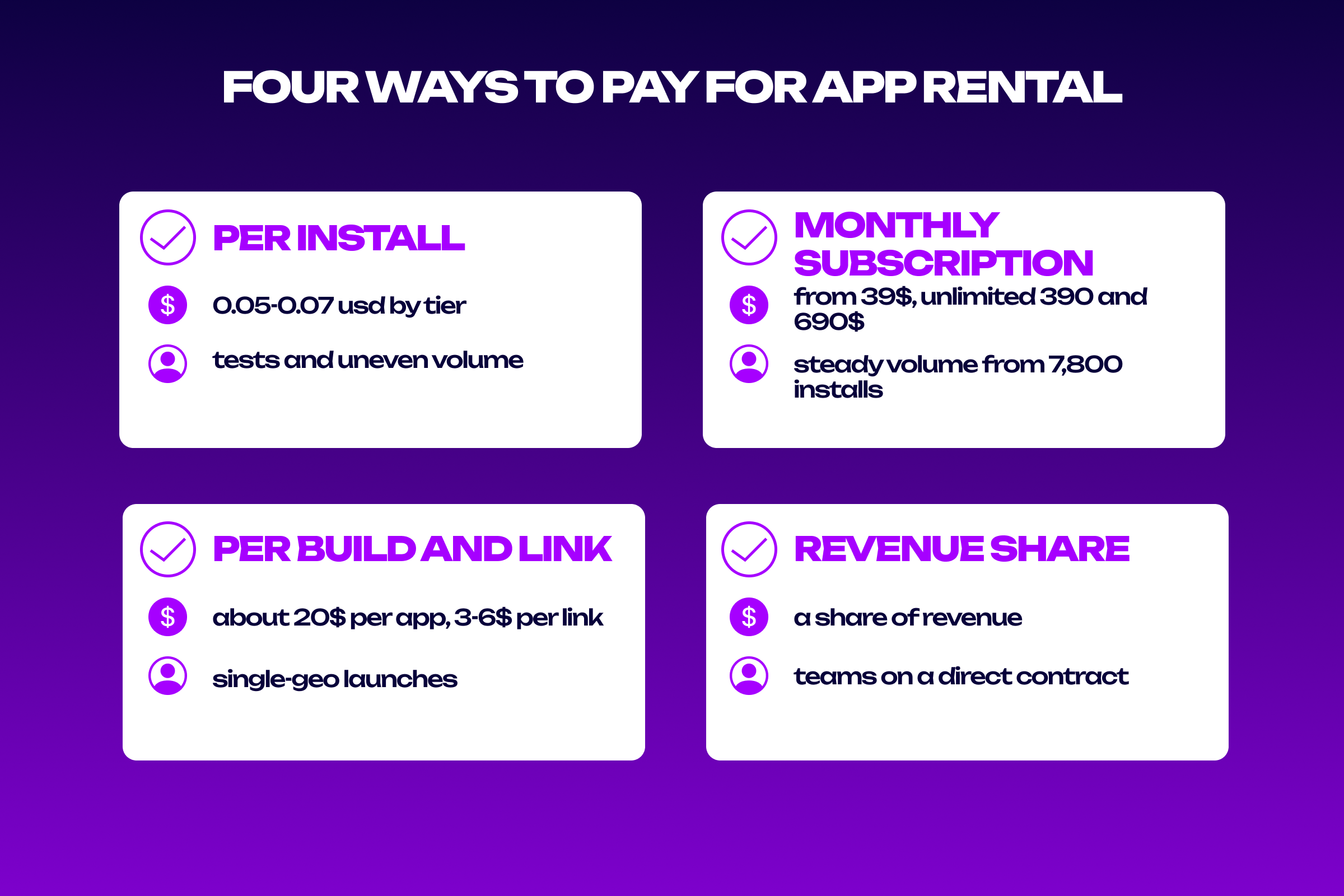
Four billing models split this market, and choosing one depends less on budget size than on how evenly volume lands across a month. Some vendors charge per install, some per month of access, some per assembled copy, a few take a slice of revenue.
| Model | What you pay for | Current range | Best fit |
|---|---|---|---|
| Per install | every install on the vendor counter | 0.05 USD on Tier-3, 0.06 USD on Tier-2, 0.07 USD on Tier-1 | tests and uneven volume |
| Monthly subscription | builder access plus the build pool | from 39 USD entry tier, 390 and 690 USD for unlimited installs | steady volume above a few thousand |
| Per build and per link | each assembled copy and each domain | roughly 20 USD per app, 3 to 6 USD per link | single-GEO launches and short tests |
| Revenue share | a percentage of what your traffic earns | terms agreed with the manager case by case | teams on a direct operator contract |
Free tiers already exist on one side of the platform divide. One vendor hands out builds for the open mobile OS at no charge and earns on the closed one, where installs run up to 0.07 USD. Another keeps a zero-cost plan next to paid tiers at 39, 99 and 199 USD.
Invoices come from the vendor dashboard, not yours, which is where arguments start. Reconcile their counter against your tracking platform weekly, because a 10% gap on 50,000 installs is 350 USD a month. Trial packs of 500 and 1,000 installs exist at several rental vendors, with deposits between 20 and 100 USD.
Rental rates age faster than anything else in the stack. Catalogues still quote 0.25 and 0.30 USD per install for vendors whose own price pages now open at 0.05 USD. Pull the figure from the live pricing page before modelling unit economics.
GEO, stores and language coverage
Handset mix decides the format long before creatives do. Worldwide the open mobile OS holds 68.36% against 31.6%, which looks settled until you zoom in. In the United States the closed platform leads 59.58% to 40.39%, so half that market cannot install an open-store build.
Language carries similar weight. App name, install-page copy and push text have to match the creative, otherwise the user abandons mid-flow. Templates for major locales usually ship with the rental account, while anything rarer you write yourself.
| GEO | Mobile OS split, July 2026 | What it means for rental |
|---|---|---|
| Worldwide | open 68.36%, closed 31.6% | build the core pool for the open platform |
| India | open 92.44%, closed 7.5% | installs at 0.05 USD, closed-OS builds are pointless |
| Nigeria | open 82.51%, closed 17.4% | cheap Tier-3 volume, local languages in push copy |
| Brazil | open 77.59%, closed 22.41% | Portuguese localisation, Tier-2 install pricing |
| United States | closed 59.58%, open 40.39% | skip closed-platform builds and half the traffic dies |
Replacement schedules follow the same map. Takedowns arrive on the local reviewer’s clock, so a rental vendor several time zones away turns a routine swap into a lost shift. Ask about the replacement window before signing.
Access, moderation and account safety
Real-money builds clear the open store only against a short checklist. A valid licence for every country of distribution, under-age blocking, free download with no store billing, geo-gating outside the licence and an adults-only rating are mandatory.
Cloaking modules that swap content after review sit outside both rulebooks. Guidelines on the closed platform ban hidden, dormant and undocumented functionality in a dedicated clause, and roughly 59,000 apps were pulled during 2025 for that behaviour.
Access hygiene is the quieter risk. A rental vendor never needs your affiliate account: an offer link and a working postback cover it. Export install stats on a schedule, since dashboard history disappears the day an account closes.
Picking an application rental vendor
Rate cards mean little in isolation. Work out where a subscription overtakes per-install billing: 390 USD covers about 7,800 installs at 0.05 USD, and 690 USD roughly 13,800. Below those thresholds pay per install, above them the flat plan wins.
Depth of pool matters less than turnaround. A vendor with ten builds runs dry on the first mass takedown, so ask how fast a replacement ships. Alongside the rest of the affiliate tooling stack, application rental sets the cost floor of a funnel.
- Match the billing model to real volume: a 390 USD subscription pays off from roughly 7,800 installs a month, and below that line per-install billing at 0.05 USD on Tier-3 stays cheaper. Run the maths before funding a balance.
- Replacement turnaround beats pool size every time: a build that only arrives next morning costs a full day of traffic plus the warmed-up ad account behind it. Get the window written down in the chat with your manager.
- Check GEO coverage country by country rather than by tier label: Brazil runs 77.59% on the open mobile OS while the United States sits at 59.58% closed, and a rental pool has to cover whichever side you actually buy.
- Trial packs of 500 or 1,000 installs exist at several vendors, and they are the only honest way to compare their counter with yours before paying. Deposits between 20 and 100 USD keep that test cheap.
Application rental mistakes that burn budget
The same four errors show up season after season, and none of them costs the price of a subscription. What they cost is the media budget stacked on top. Buyers price the install and forget to price downtime.
- Scaling spend right after the first install, without ever reconciling the vendor counter against a tracker. A 10% discrepancy on 50,000 installs runs to 350 USD a month, and it usually surfaces around the third invoice.
- Signing without asking about replacement times, then waiting two days for a fresh build. The ad account cools off meanwhile, bids have to be pushed back up, and the week after a ban ends up dearer than the month before it.
- Ordering closed-platform builds for a GEO where that platform holds 7.5% of handsets, as in India. The premium install fee is charged in full while volume never appears, because the audience is on the open OS.
- Switching on a cloaking module for an offer with no licence in the target country, which the store demands in its own clause. The app dies at first review and takes the developer account with it, billed separately.
The expensive line in application rental is not installs, it is the hours between a takedown and a replacement. Price one silent day of your ad account and haggling over 0.01 USD per install stops looking important.
Application rental FAQ
Five questions rental vendors field more often than the rest, answered against public price pages and store rules as they stand in August 2026.
What does application rental cost to start?
Around 20 USD, the entry deposit at vendors billing per install. From there it scales linearly: a thousand Tier-3 installs runs about 50 USD, the same volume on Tier-1 about 70 USD. A free pack of 500 or 1,000 installs is common.
PWA or native shell for a first campaign?
PWA. No store gates it, it installs from the browser, and a banned domain is replaced within minutes. Native shells earn organic pickup from store search yet cost up to 0.15 USD per install and need a stock of developer accounts.
How long does a rented build survive?
Grey builds on the open store are reported at 4 to 16 days, and web shells seldom run past three weeks. A PWA lasts exactly as long as its domain. Plan around scheduled replacement instead of one long-lived build.
What is warm-up for?
Warm-up is the first stretch when a build takes modest, comparatively clean traffic so its profile reads as ordinary to store systems. Firing tens of thousands of installs from one source on day one looks anomalous.
Can I rent without my own developer account?
Yes, and that is the point of the model: the account belongs to the vendor, and so does the ban risk. Your own would run 25 USD once on the open store or 99 USD a year in the closed ecosystem, plus 12 testers across 14 days.
Closing notes
Application rental is bought for replacement speed, not for the format itself. Stores rejected millions of submissions during 2025 and closed hundreds of thousands of developer accounts, so the question is never whether a build gets pulled.
Weigh vendors on billing model against monthly volume, the replacement window, GEO coverage on both platforms and how openly the install counter reports. Current rental rates and trial terms for each service sit in the cards above.