
11.08.2026

Yelyzaveta Zorenko
Author
Telegram Ads looks like a cheap way in until you compare what you deposit with what actually leaves your account: a 250 EUR minimum top-up at a reseller becomes 366 EUR once the 20% fee and 22% VAT are added, and the floor CPM in a euro cabinet has sat at 0.70 EUR since 17 February 2026, down from a full euro. The messenger crossed a billion monthly users back in March 2025 and still carries a fraction of the ad load Meta does, which is exactly why affiliate teams keep circling it. What follows: the three separate markets hiding behind the phrase “Telegram traffic”, the true cost of a budget, rate ranges by GEO, clause 5.6 of the ad policy, and the question nobody in this niche likes answering, which is who pays the fine when a regulator arrives.
Three markets, one confusing label
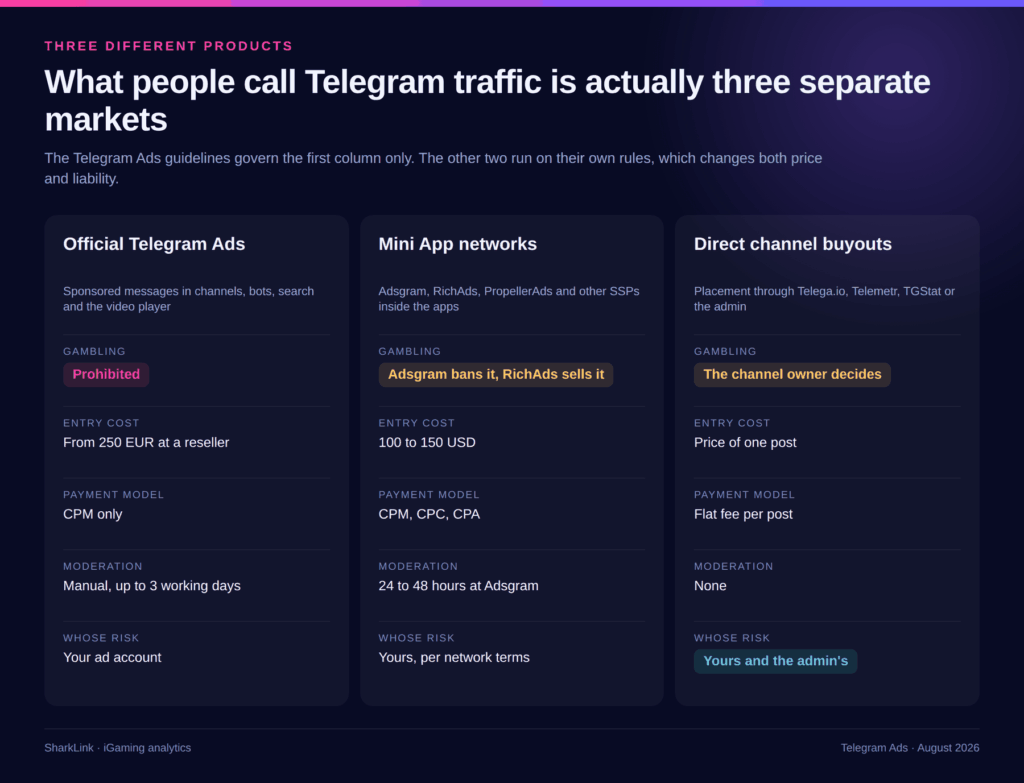
The confusion is baked into the vocabulary. “Advertising on Telegram” can mean three products that differ in format, entry cost, payment model, moderation and, most importantly, whose rulebook you are breaking when something goes wrong. Sort them out before your first deposit, because several English-language guides list all three in a single comparison table as though they were interchangeable.
The official platform and sponsored messages
Product one is the Telegram Ad Platform at ads.telegram.org. There is a single format: a sponsored message of up to 160 characters including spaces, one button, optionally an image or a video. It surfaces in public channels below the last post, in bots above the input field, in global search results, and as text inside the fullscreen video player. Targeting a named channel requires that channel to hold 1000 subscribers or more. Owners keep 50% of the ad revenue, paid out in TON through Fragment. Telegram Premium subscribers never see sponsored messages at all, and there were more than 15 million of them as of May 2025.
Mini App networks and buying posts outright
Product two is third-party inventory inside Telegram Mini Apps, sold by Adsgram, RichAds, PropellerAds and other SSPs. Different formats apply there: rewarded interstitials, banners, playables, in-bot placements, billed by CPM, CPC or CPA, with entry at 100 USD on Adsgram and 150 USD on RichAds. The Telegram Ads guidelines do not govern this inventory, though each network’s own rules do. Product three is buying a post directly, through Telega.io, Telemetr, TGStat or the channel admin. Nothing is moderated here by anyone: Telega.io’s own rules put the publishing decision entirely with the channel owner, while the exchange keeps 12.5% from the owner and 15% from the advertiser’s deposit.
| Parameter | Official Telegram Ads | Mini App networks | Direct channel buyouts |
| Format | Sponsored message, 160 characters | Banner, rewarded, playable, in-bot | An ordinary post of any length |
| Entry cost | From 250 EUR at a reseller | 100 USD Adsgram, 150 USD RichAds | Price of one placement |
| Payment model | CPM only | CPM, CPC, CPA | Flat fee per post |
| Gambling | Prohibited under clause 5.6 | Adsgram bans it, RichAds and PropellerAds sell it | The channel owner decides |
| Moderation | Manual, up to 3 working days | 24 to 48 hours at Adsgram | None |
| Whose risk | Your ad account | Yours, per network terms | Yours and the admin’s |

What entry costs and how much of it buys impressions
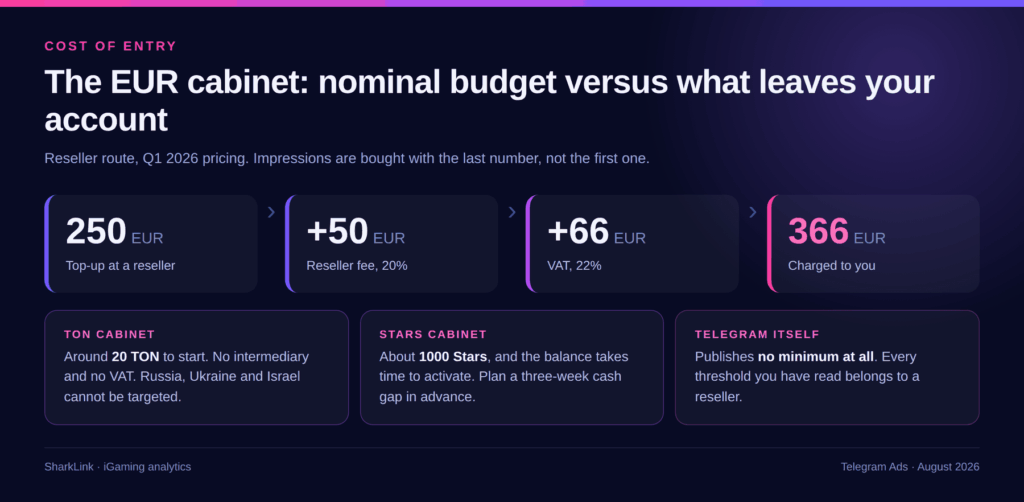
Telegram publishes no minimum budget. None at all. The ads.telegram.org page carries no deposit threshold, no minimum spend and no rate card, only the line about a billion users and a trillion monthly views. Every threshold you have ever read belongs to a reseller, which is precisely why the numbers differ between sources and go stale every few months.
A euro cabinet through a reseller
Most CIS teams take the reseller route into a euro cabinet. Click.ru dropped its minimum top-up to 250 EUR in February 2026; eLama had been running the same threshold since October 2025. Then comes the arithmetic that competitor guides tend to leave unfinished: 250 EUR plus a 20% reseller fee plus 22% VAT means 366 EUR leaves your account. Fees float by vertical and reach 30% in crypto, some platforms still hold the older 500 EUR floor, and Russian legal entities carry an additional 3% advertising levy on top.
TON, Stars and why the thresholds disagree
The self-serve alternative is a TON cabinet: sign in with a phone number, fund it in Toncoin, no intermediary and no VAT. Roughly 20 TON gets you started, though confirm the current figure before depositing since it tracks the exchange rate. One restriction matters a great deal: the TON cabinet cannot target Russia, Ukraine or Israel, and external links are not permitted in that mode, so traffic has to land on a channel or a bot. A Stars-funded cabinet exists too, but the balance takes time to activate, so build a three-week cash gap into the plan rather than discovering it mid-launch.
| Line item | Amount | Note |
| Top-up | 250 EUR | Click.ru floor since 02.2026, eLama since 10.2025 |
| Reseller fee | +50 EUR | 20% standard, up to 30% in crypto |
| VAT | +66 EUR | 22% on the total including the fee |
| Charged to you | 366 EUR | 250 EUR reaches the auction, the rest is the cost of access |

Bidding and the auction in 2026
One payment model exists in the official cabinet: CPM. No CPC, no conversion optimisation, no campaign hierarchy. You name a price per thousand impressions and compete for the same inventory as everyone else, and Telegram serves whoever pays more. That makes the published floor a reference point rather than a rate: in a contested topic the auction clears several times above it.
The floor after 17 February
Minimum bids in euro cabinets have been cut twice. August 2024 took the floor from 1.50 to 1.00 EUR; 17 February 2026 cut it another 30%, to 0.70 EUR. The news and politics category fell from 0.50 to 0.35 EUR, and ads carrying an image from 1.50 to 1.05 EUR. Format limits did not move at all: still 160 characters, still one button, still 1000 subscribers before a channel can be targeted by name. Plenty of industry articles refreshed in spring 2026 still quote one euro as the minimum.

What a thousand impressions actually costs by GEO
Telegram issues no rate card, so every CPM-by-country table in circulation comes from a company that sells the inventory. The two freshest datasets disagree by roughly 2x on Brazil and close to 2x on the United States, and neither is simply wrong: different platforms hold different auction access, different cabinets and different samples. The useful response is not to average them but to plan against the upper bound.
| GEO | ADSLY, USD | RichAds, USD | Spread |
| United States | 2.80 | 4.00-5.00 | up to 1.8x |
| United Kingdom | 2.80 | 4.00-5.00 | up to 1.8x |
| Germany | 2.50 | 3.00-4.00 | up to 1.6x |
| Brazil | 1.50 | 3.00-3.20 | up to 2.1x |
| India | 1.20 | 1.20-2.00 | up to 1.7x |
| Indonesia | 1.00 | 1.50-2.50 | up to 2.5x |
| Kazakhstan | 0.90 | not published | no comparison |
| Ukraine | 0.75 | not published | no comparison |

Only one dataset comes with a disclosed method behind it. The eLama index for January 2026 draws on more than a million active campaigns run since August 2022, and it covers Russia only. Marketing tops that table at 10 EUR per thousand impressions while games and blogs sit at 3 EUR. Gambling appears nowhere in the index, and the reason is not sampling.
What Telegram bans in plain language
Clause 5.6 of the ad guidelines does not hedge: ads must not promote online or offline gambling, gaming, or casino-based activities involving real money, prizes, or goods of any value. Sports betting, lotteries, bingo and fantasy sports are named as examples, with tips, odds and sports picks listed separately. No licensing carve-out appears anywhere in the text. There is no “permitted in regulated markets”, no certification route, nothing resembling what Google and TikTok operate. The section closes by noting that its examples are non-exhaustive.
The neighbouring clauses that kill an affiliate stack
Set the vertical aside and the standard affiliate setup still collides with four more rules. Link shorteners and bare IP addresses are banned in their own right, even when the final destination is legitimate. A landing page that fires a 302 or htaccess redirect fails review. Cloaking and spoofed destinations carry suspension without notice, which the policy states outright. Absolute claims such as “highest incomes” are refused on their own merits, and a separate clause prohibits promoting services that inflate traffic or metrics.
- A shortened link in the creative is refused even when the final domain is clean.
- The destination must match the ad copy and cannot act as an intermediate redirect.
- Cloaking carries account suspension with no prior warning under the published policy.
- Channel language, ad language and landing page language are required to match.
- A channel with no post in the previous two weeks will not clear review.
What happens in practice
The gap between the policy text and the live feed is documented. On 30 June 2026 the Spanish outlet Maldita identified 13 ad campaigns running on media and government channels with a combined 280,000-plus subscribers, five of them betting ads, none of the advertisers appearing in Spain’s register of licensed operators. Telegram told the journalists that ads are reviewed before being displayed; the ads were still live when the piece went out, and some carried no report button. The company also maintains it has fewer than 45 million users in the EU, which keeps it outside the very large platform regime under the DSA.
“The market reads this as permission when it is really a hole in moderation. The distinction matters: on Google and TikTok the vertical opens against a licence and the account survives for years, on Telegram you run until the first review and nobody compensates a frozen account.” SharkLink team
Building an iGaming funnel: bot, channel or direct link
Since the official cabinet will not pass direct casino traffic, the market built a detour: the ad points at your own channel or bot, and the offer is delivered from there. That removes the landing page from moderation’s line of sight, but it adds a step and it eats conversion. Cost per subscriber through Telegram Ads runs 80 to 120 roubles in mass-market topics and 300 to 500 in competitive ones, meaning you have paid twice before a first deposit exists.
Why case-study numbers need dividing
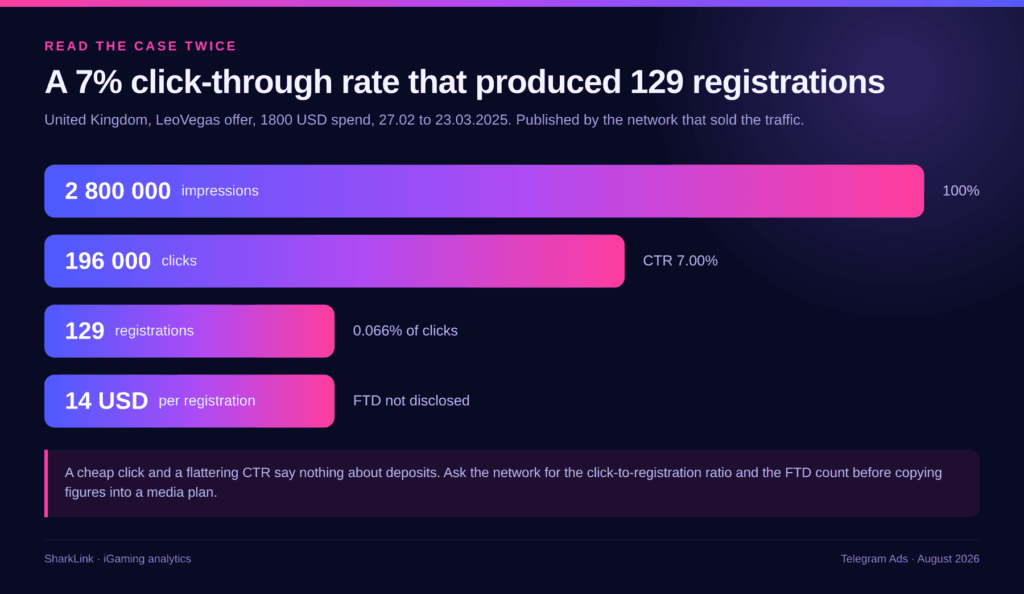
The clearest example was published by the network selling the traffic. A RichAds case in the United Kingdom: 1800 USD spent, 2.8 million impressions, 196,000 clicks, 7% CTR, one cent per click. Then 129 registrations at 14 USD each, and there the figures stop, with no FTD disclosed. Do the division yourself: 129 registrations out of 196,000 clicks is 0.066%. A cheap click and a flattering CTR inside Mini Apps mean nothing until deposits are shown, and rewarded formats count a compelled interaction as a click.
Numbers from the affiliate-programme side look more grounded. Registration to deposit in the CIS is put at 7 to 9%, individual LatAm setups have cleared 20%, and click to FTD lands between 1 and 2%. Time to deposit really is shorter than on Facebook, with the decision often taken inside an hour. Player lifespan from this source rarely passes two months, and bot or scripted clicks are estimated at up to 25% of the total.
- Open a cabinet and fund the minimum, budgeting the deposit together with fee and VAT.
- Assemble a pool of 15 to 20 channels above 1000 subscribers, matching the ad language.
- Prepare the destination channel or bot with real content at least two weeks before launch.
- Write 4 to 6 copy variants inside 160 characters, with no absolute claims and no shorteners.
- Start at the 0.70 EUR floor and lift the bid in 10 to 15% steps until delivery stabilises.
- Pass the start parameter into your tracker and count deposits rather than subscribers.

Tracking: stitching an impression to a deposit
Cabinet reporting stops at the click and the affiliate programme starts at the registration, with nothing in between until you build the bridge. The working pattern: the bot link carries a start parameter holding a unique token, the bot passes that token and the Telegram ID to your tracker, the tracker writes it into the programme’s sub-account, and the postback returns the deposit against the same token. Keitaro and Binom both handle this. Skip it and you will optimise toward cost per subscriber while the programme pays on FTD, two metrics that diverge by an order of magnitude.
The legal layer: who actually pays the fine
The most common misreading of risk is assuming the operator carries it. Across most jurisdictions the distributor of an ad is liable separately from the advertiser, and the affiliate turns out to be the easiest target a regulator has.
Ukraine
Article 22-1 of the Advertising Law bans gambling advertising and then lists a closed set of exceptions. Messengers are not among them. There is a provision covering information-sharing platforms, video-sharing platforms and search engines, conditional on the technical ability to direct advertising at people over 21, and whether a public Telegram channel meets that definition has no case law behind it yet. The same part separately prohibits sending messages to an indeterminate group of people through electronic communications. Only a holder of a Ukrainian licence may commission the advertising, and the age threshold is 21, not 18.
PlayCity’s enforcement record shows the direction of travel. On 8 July 2026 the administrator of a Telegram channel was fined 5.2 million hryvnia for systematically advertising unlicensed casinos between April and September 2025. The Trukha channel had taken 4.8 million earlier, and by April 2026 the agency had issued 67.2 million hryvnia in fines across 16 entities, with none paid voluntarily.
Russia, Brazil and Asia
In Russia, part 10.7 of article 5 of the advertising law has banned advertising on restricted-access resources since 1 September 2025, and the FAS extended that reading to Telegram. On 25 March 2026 the agency announced a transition period running to the end of 2026 during which no penalties apply. Sanctions under article 14.3 of the administrative code reach 2500 roubles for individuals, 20,000 for officials and 500,000 for legal entities. Brazil, from 17 July 2026, requires advertisers, agencies and platforms to verify an operator’s authorisation before placement, with the risk warning occupying at least 10% of the material. India’s real-money gaming ban took effect on 1 May 2026, and the state of Tamil Nadu had already blocked three Telegram groups along with their admins in January. The Philippines, in February 2026, agreed monthly content-removal reporting with Telegram in exchange for dropping a national ban.
“Spain’s regulator has already fined an affiliate for promoting an unlicensed operator on social platforms, and Ukraine’s agency fines channel admins rather than casinos. Traffic jurisdiction now weighs as much as approval rate, and it has to be priced in before the campaign, not after the letter arrives.” SharkLink analysts
One more check belongs before launch: whether your affiliate programme accepts Telegram Ads traffic at all and how it must be labelled in reporting. Source rules vary between programmes far more than commission rates do. Current terms are collected in the SharkLink affiliate programs catalog, and the full policy text sits on the Ad Policies and Guidelines page.
Questions that keep coming up
Is there a legal way to advertise a casino through Telegram Ads?
No. Clause 5.6 bans gambling advertising with no exception for licensed operators, and Telegram runs no certification process comparable to Google’s or TikTok’s. Reseller promises of 95% approval rates for the vertical are intermediary marketing, not platform policy.
What does a first test cost?
Through a reseller into a euro cabinet, 366 EUR charged for 250 EUR of usable budget. At the 0.70 EUR floor that buys roughly 350,000 impressions, enough to test two or three angles and nowhere near enough to draw conclusions about a GEO.
Why do ads get rejected when the vertical is clean?
The frequent causes have nothing to do with the topic: a shortened link, a destination that does not match the copy, a redirect on the final page, an empty channel with no posts for two weeks, and absolute claims in the creative. Review is manual and takes up to three working days.
How do Mini Apps differ from the official cabinet?
They are separate marketplaces with separate rules. Gambling is banned in the official cabinet and banned by Adsgram under clause 1.4, while RichAds and PropellerAds sell iGaming openly across their Mini App inventory. Rates there are lower and so is traffic quality.
Who is liable for unlawful advertising, the operator or the affiliate?
Both, and separately from one another. PlayCity fines channel administrators, Spain’s DGOJ fined an affiliate in May 2026 for promoting an unlicensed operator, and Brazil’s July 2026 rules put the authorisation check on the distributor.
Yelyzaveta Zorenko
Author
Similar articles by the author

Leave a comment
Thank you for your feedback!
Your review will be published after moderation.