
11.08.2026

Yelyzaveta Zorenko
Author
Most reviews of gambling traffic sources just restate the platforms’ ad policies and stop there. In practice a media buyer picks a channel not by targeting quality but by whether they can even get access to it. Google is updating its certification forms for all gambling jurisdictions from August 26 2026, and from September 14 it requires “good policy standing” from every account. Meta already moved gambling permissions into the Permissions and Verifications section inside Business Manager back in summer 2025. That is why this review is built around access and cost of entry, not around reach. For each source below: a short description of how it actually works in 2026, then the advantages, disadvantages, and who it suits. All the figures and rules are checked against platform policies and ad network documentation as of August 2026. Where grey mechanics operate in gambling (cloaking, app rental, account farming), we describe their economics honestly, with the risks, rather than as a step-by-step evasion guide.
The key point about access
Push, popunder, in-app, and native collect the bulk of affiliate budgets in gambling not because they convert better than Meta, but because they are channels an affiliate can buy without a licensed legal entity. Google and Meta offer the most precise targeting and, for most readers of this review, are someone else’s channel, access to which opens only through a partnership with an operator.
Hence a simple framework for choosing. First the access question: can I even buy traffic here at all. Then the durability question: how long a bundle lives before you have to rebuild it. And only then the efficiency question. Channels that start today (network push, pop, native) constantly degrade and need creative refreshes. Channels that take months (SEO, relationships with streamers) take a long time to launch but hold up.
Facebook and Meta Ads
Meta is the clearest example of a channel that looks accessible and is not. Launching gambling ads on Facebook and Instagram requires permission via Permissions and Verifications in Business Manager, with a manual license check for every GEO you target. There is no separate affiliate track: permission goes to licensed legal entities. Where affiliates do work with Meta traffic officially, the operator usually runs the campaigns themselves and pays on CPA or a hybrid, or takes the affiliate on as a buyer on their certified ad account.
The grey part of the market runs on agency ad accounts and cloaking. Here you see “king accounts” trading at $7-10, ad account rental at roughly $25 for 10 days, consumables (proxies, antidetect, domains) from $50-80, and a starting test budget set at $500-2000. Cloaking splits a white page for the moderator and a black page for the player via trackers like Keitaro or Binom. WebView apps in this scheme live 3-7 days, and “ban waves” wash out even warmed-up accounts. This is a genuinely working mechanic, with ROI cases from 69 to 700+ percent, but with high variance and constant recovery costs.
Advantages:
- The most precise targeting by interests, behavior, and Lookalike among all the paid channels in this review.
- Huge traffic volume in Tier-1, where the user spends over an hour a day in the app.
- Reels and Stories formats give a high CTR for casino creatives even on a small test.
Disadvantages:
- There is no separate affiliate certification, so without a licensed legal entity you cannot pass the check directly.
- The grey scheme means constant spend on consumables and cloaking, plus the risk of losing your budget along with a ban.
- Restrictions come fast and without explanation, and an appeal drags on for weeks while campaigns sit idle.
Best suited for: licensed operators and teams that can pass certification officially. For an affiliate, the real way in is an arrangement with an operator who already has access, or an experienced team with a ready infrastructure of consumables and cloaking.
Google Ads
Google gives the warmest paid traffic in gambling: the person is already searching for a casino or a bonus, and all that is left is to intercept the query. But from 2026 the channel is closing ever tighter. From August 26 the certification forms are being updated for all jurisdictions, and from September 14 every account has to demonstrate “good policy standing,” meaning no recent violations, in order to apply for or renew certification. A license is required for every targeted region. Affiliates without their own license must drive traffic only to operators licensed in the target region, and state this plainly in the site footer.
In practice this means clean Google without a license is available either through an operator’s certified ad account, or via the grey scheme through agency accounts and cloaking, with its own bans and consumables, just like on Meta. For betting the logic is similar, but the list of allowed GEOs is wider than for casino.
Advantages:
- The warmest intent: a user in search is already ready to act, and conversion to registration is higher than on cold channels.
- UAC and app campaigns scale well for mobile gambling in allowed GEOs.
- A transparent auction and solid analytics make optimization easier.
Disadvantages:
- Certification is tied to a license in every GEO, and the “good policy standing” requirement from September 2026 raises the barrier to entry.
- A single account cannot hold certification for online gambling and for social casino at the same time.
- About 55 countries allow gambling advertising at all, and the rest are out of play.
Best suited for: operators with a license for specific GEOs and affiliates who work in tandem with such an operator. Search intent here is too valuable to hand off blindly to a grey scheme without experience.
TikTok
TikTok is the cheapest Tier-1 attention and the hardest moderation at the same time. Officially gambling here requires certification and a local market license, there is no separate affiliate track, and the audience age cannot be lowered below what is permitted. The June 2026 update, for example, added social casino for Guatemala as a permission-based format, which shows how selectively the platform opens the category.
So in gambling TikTok works mostly as an organic and semi-organic channel. Media buyers farm accounts, post short warm-up videos, and lead the audience into Telegram or to a prelanding. Organic content becomes a problem for the platform where a video directly says “play now,” promises a bonus, or points to “the link in bio,” so such content balances on the edge and accounts get taken down regularly. This is a channel of cheap reach at the price of constant farming and replacements.
Advantages:
- The cheapest way to capture attention in Tier-1 and phenomenal organic reach among a young audience.
- Short videos produce a viral effect you cannot buy with banners.
- A low barrier to entry for organic: you need content and accounts, not an ad budget.
Disadvantages:
- There is no direct affiliate gambling advertising; the official path is a license plus certification.
- Accounts used for organic warm-up get taken down for violations, so you need constant farming and a reserve.
- The audience is young, and part of the GEOs drop out due to age and local bans.
Best suited for: teams that know how to make content and scale account farming, as well as operators with a license for a specific market. For a solo newcomer without a stream of accounts, the channel is unstable.
Telegram
Telegram is noticeably more lenient toward gambling than Meta and Google, and in 2026 it is one of the backbone channels. It works in three ways: official Telegram Ads, advertising in Mini Apps through partner networks, and direct seeding in themed channels. Mini Apps give access to 70M+ active users, and moderation in partner networks is softer than the official platform’s, so the category passes more easily.
Price benchmarks via networks: a minimum daily budget from $25, push format from $0.015 per click, a fullscreen banner from $1.5 per thousand impressions, video from $3 per thousand, an embedded banner from $0.4. The main risk is quality: bots and inflated numbers in channels, which is why traffic is always run through a tracker (Binom, Voluum) with frequency caps set so as not to burn out the audience.
Advantages:
- Leniency toward gambling is higher than on the big platforms, and the category passes moderation more easily.
- High CTR and a native feel to ads in the messenger, with a lower cost per click on a warmed-up audience.
- Flexible formats: from seeding in niche channels to Mini Apps with playable ads.
Disadvantages:
- Manual selection of channels for seeding and the risk of inflated numbers and bots; sources need to be vetted.
- Traffic quality swings a lot between channels, and without a tracker it is easy to burn through your budget.
- Official Telegram Ads has its own restrictions, and the bulk of gambling volume goes through third-party networks.
Best suited for: affiliates who test many GEOs and creatives on a controlled budget, and teams with their own themed channels. A good first paid channel for those who are not let into Meta and Google.
SEO
SEO is the slowest start and the most durable result. In gambling it is a long game: by estimates from ICE Barcelona (January 2026), 40-50 percent of popular iGaming queries in the SERPs are occupied by parasite pages on ultra-authoritative domains, so a new affiliate project on mid-competition queries can realistically reach the top in 12-24 months and close the authority gap in 18-36 months. An editorial link on an industry publication costs roughly 500-2000 euros.
But traffic quality is the highest of all channels. The organic user arrives with direct intent, and reg-to-dep conversion for SEO is estimated at 20-60 percent versus 15-30 for in-app. This makes SEO ideal for RevShare, where the long-term value of the player matters. The main risks are Google updates that punish over-optimized anchors, and dependence on someone else’s domain in the parasite scheme.
Advantages:
- The highest traffic quality and intent, and the best conversion to deposit among the channels in this review.
- No platform gatekeeping and no ad account bans; the asset accumulates and works for you.
- Fits RevShare perfectly thanks to the long-term value of the organic player.
Disadvantages:
- A long climb to the top (a year or more) and noticeable spend on content and links.
- Search updates can sink your positions, and parasite schemes depend on someone else’s domain.
- Expertise is required: technical SEO, link building, content architecture.
Best suited for: teams and affiliates with a planning horizon of a year or more and a budget for content, especially those working on RevShare. Not suitable if you need a result this week.
Push notifications
Push is the workhorse of affiliate gambling: the cheapest entry and full control without cloaking. Classic push arrives as a system notification, while in-page push works even on iOS. Prices from $0.003-0.01 per click make the channel the cheapest to start with, especially in Tier-3. A campaign passes moderation in 10-15 minutes, and the minimum deposit at networks is around $250.
The weak spot is targeting: mostly GEO, device, age, and gender are available, with no fine-grained interests. So push is taken by volume and hard optimization, cutting off weak sources after 1000-2000 clicks. The creative decides everything: a short headline up to 30 characters, a clear icon, an emoji, a timer, and an emphasis on the bonus. Push works best in Germany, Indonesia, Bangladesh, Brazil, and Australia.
Advantages:
- The lowest barrier to entry and cost per click, a fast start, and fast moderation.
- No cloaking needed; most networks accept gambling openly.
- Large volume in Tier-3 and easy scaling of winning bundles.
Disadvantages:
- Poor targeting: only GEO, device, age, and gender, with no deep interests.
- A lot of junk and bot traffic; sources need constant cleaning.
- Fast creative burnout; you have to refresh headlines and icons often.
Best suited for: newcomers and teams that want to quickly test an offer and GEO on a small budget, as well as buyers who know how to optimize volume. This is the most logical first channel in gambling.
Native advertising
Native is advertising embedded into a site’s content in the form of recommended materials. It gets past banner blindness and adblocks and gives a warmer click than push or pop, because the user perceives it as part of the article. Gambling networks accept native by volume, and payment is usually per click. The cost per click is higher than push, but the traffic is also more deliberate, so the channel holds up prelandings with storytelling and quizzes well.
The price for this is source quality: in native, as in pop, there are many junk placements and a risk of fraud, so sources here are selected by conversion to deposit rather than by cheap impressions. The classic native bundle is a warm-up through a content prelanding (a winning story, a strategy breakdown) with a transition to the offer.
Advantages:
- Gets past banner blindness and adblocks; the click is warmer than push and pop.
- Works well with storytelling prelandings and quiz funnels.
- Large inventory and scale through programmatic and native networks.
Disadvantages:
- A more expensive click than push, and the need for a quality prelanding.
- Risk of fraud and junk placements; sources must be selected by quality.
- More complex analytics: you have to evaluate player value, not CPM.
Best suited for: buyers who know how to build content funnels and are willing to pay for traffic quality rather than the cheapest impression. A good second channel after push, once you have something to warm up.
In-App and app rental
In-App is advertising inside mobile apps and traffic from rented gambling apps. Since the app stores reject real-money casino, the market runs on renting ready-made shell apps (WebView or PWA) that carry the player to the offer. Rental costs roughly $0.05-0.20 per install depending on the service and volume, and the app itself lives for something like 50-100 thousand installs before a ban, after which it is swapped for a new one.
The point of the channel is that an app gives high engagement, builds a base for push, and feeds well on traffic from UAC, TikTok, or Facebook while it lives. Reg-to-dep conversion for in-app is estimated at 15-30 percent, lower than SEO, but volume and speed are higher. The main risk is the plain ban of the shell in the store, so the work is built around a stock of apps and fast replacement.
Advantages:
- High engagement and convenient collection of a push base right inside the app.
- Renting removes the need to develop the app yourself and push it through the store.
- Combines well with UAC and social media as install sources.
Disadvantages:
- Apps get banned regularly; you need a stock of shells and a budget for replacements.
- Payment per install plus the cost of the traffic itself raise the total cost of entry.
- Conversion to deposit is lower than for search and SEO traffic.
Best suited for: teams that drive mobile gambling at volume and have the infrastructure to replace apps. For a solo newcomer, the barrier and operational complexity are too high.
Popunder and Pop traffic
Pop is the cheapest volume in gambling. Popunder opens in a background tab, popup over the page. Prices from $0.5 per thousand impressions mean the channel delivers mountains of cheap impressions without cloaking. The payoff is quality: the traffic is cold and often random, so pop is almost always run through an aggressive prelanding with a quiz or a “wheel of fortune” to filter out the random ones and warm up the rest.
Direct click (domain traffic) stands apart, when the user is redirected from parked domains. It is more expensive (from $1.5 per thousand), but by network estimates it converts noticeably better than ordinary popunder because it is closer to intent. The best GEOs for pop are Bangladesh, Turkey, Indonesia, Azerbaijan, and Canada.
Advantages:
- The cheapest volume of impressions among all channels, and an instant start without cloaking.
- Huge scale in Tier-3; it is easy to gather statistics for tests.
- Direct click offers a warmer subtype of the same channel for more expensive GEOs.
Disadvantages:
- The coldest and lowest-quality traffic, with a high level of fraud.
- Without a strong prelanding, conversion is close to zero.
- Many junk placements; hard cleaning and blacklists are required.
Best suited for: buyers who drive volume and know how to make filter prelandings, and those who quickly test many GEOs cheaply. Not suitable for delicate offers that require a quality audience.
YouTube
YouTube works in gambling in two ways: paid pre-roll and integrations with bloggers. Pre-roll (a short video before the clip) gives high engagement and reach, but officially it falls under the same Google gambling policy, meaning it requires certification. So affiliates more often go through direct integrations with bloggers and streamers, or build their own niche channel for casino content and gather organic traffic.
This is more of a long-term audience-building channel than a quick blast of traffic. Your own channel and relationships with bloggers accumulate trust that then converts steadily, but they require time and content.
Advantages:
- High engagement of the video format and reach of a warm audience through integrations.
- Your own niche channel gives organic traffic you do not have to buy each time.
- Integrations with bloggers get around some of the advertising restrictions.
Disadvantages:
- Paid pre-roll falls under Google certification, just like search.
- Building a channel and an audience takes time and content; it is not a quick start.
- The quality of integrations depends heavily on the specific blogger.
Best suited for: teams ready to build content and an audience for the long haul, and those who work through influencers. Not for a quick offer test.
Streamers and influencers
Advertising through casino streamers and influencers is a relationship channel: an arrangement made directly or through an agency, paid on a flat fee, CPA, or a hybrid. A streamer’s audience is already warmed up to the topic, so the click from here is warm, and the format itself gets around platform ad moderation because it is organic content, not an ad. Reference guides recommend themed placements and streamers to newcomers for good reason: entry requires no cloaking and no agency ad accounts.
The downside is the manual nature of the work: every collaboration has to be found, negotiated, and measured, and quality depends heavily on the specific person and their audience. But a successful long-term bundle with a streamer gives a steady flow without a daily fight against bans.
Advantages:
- A warm audience already engaged with gambling and a high level of trust.
- Gets around platform ad moderation because it works as organic content.
- Long-term relationships give a steady flow without ad account bans.
Disadvantages:
- Manual searching and negotiating for every collaboration, and poor scalability.
- Quality depends entirely on the influencer and the cleanliness of their audience.
- Harder to measure and forecast than network traffic.
Best suited for: affiliates who know how to build relationships and work for the long haul, and newcomers who want to enter gambling without cloaking and agency ad accounts. It complements SEO nicely as a second durable channel.
Other sources
A few channels sit at the center less often but cover specific tasks:
- Direct Click (domain traffic). A redirect from parked domains. More expensive than pop (from $1.5 per thousand), but warmer and closer to intent. Suitable for more expensive GEOs as a subtype of pop.
- Pre-roll video outside YouTube. Short videos in networks from $0.05 per thousand impressions, with a high CTR. Suitable for reach and warm-up before the offer.
- Email and SMS campaigns. A working retention channel on your own base, weaker as a cold source due to anti-spam. Suitable for those who have already gathered a base from other channels.
- Scheme traffic. Works for those who lack skills in other sources, but not all operators accept it. Before running traffic, always check the terms with the affiliate program.
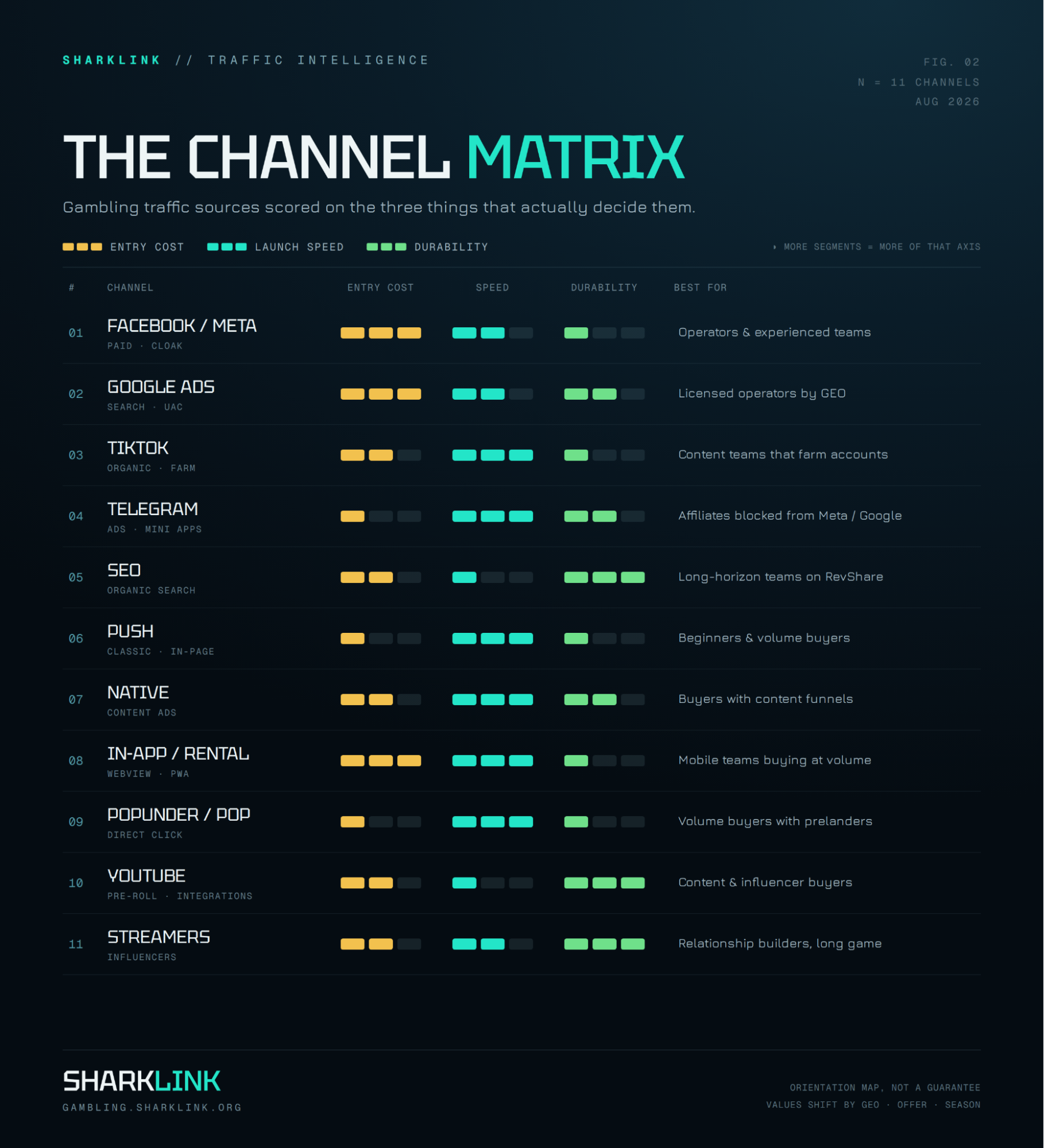
Source comparison table
A rough map of channels by entry, start speed, and durability. “Speed” is how soon the first traffic starts, “durability” is how well a bundle holds up without rebuilding.
| Channel | Cost of entry | Start speed | Durability | Primarily for
|
|---|---|---|---|---|
| Facebook / Meta | High (consumables, cloaking) | Medium | Low | Operators and experienced teams |
| Google Ads | High (license, certification) | Medium | Medium | Operators with a per-GEO license |
| TikTok | Low (organic) / high (official) | Fast | Low | Content teams with account farming |
| Telegram | Low | Fast | Medium | Affiliates not let in by Meta/Google |
| SEO | Medium (content, links) | Slow | High | Teams in for the long haul, on RevShare |
| Push | Very low | Very fast | Low | Newcomers and volume buyers |
| Native | Medium | Fast | Medium | Buyers with content funnels |
| In-App / rental | High (rental + traffic) | Fast | Low | Mobile teams working at volume |
| Popunder / Pop | Very low | Very fast | Low | Volume buyers with prelandings |
| YouTube | Medium | Slow | High | Content teams and influencer buyers |
| Streamers | Medium | Medium | High | Those building relationships for the long haul |
Payment models
A traffic source should be chosen together with the payment model, because they need to match on the “temperature” of the traffic.
- CPA. A flat fee for a target action (usually the first deposit). Best for fast network channels: push, pop, native, in-app, where a predictable cost of conversion here and now matters.
- RevShare. A percentage of the operator’s profit from the referred player over their entire lifetime. Fits quality channels with long-term value: SEO, streamers, your own content placements.
- CPL. Payment for a lead (a registration without a deposit). An intermediate model for warm-up and base-building, often paired with subsequent retention.
- Hybrid. CPA for the first deposit plus RevShare on subsequent activity. A compromise that lowers risk for both the affiliate and the operator, convenient for mixed sources.
The simple logic: cold fast traffic is taken on CPA, warm long-term traffic on RevShare, and when uncertain, take a hybrid.
GEO and market tiers
GEO determines both the price of traffic and the psychology of the player. Simplified, markets are divided into tiers.
Tier-1 (US, Germany, Australia, Canada, UK). The player plays for entertainment, the average check and LTV are high, but traffic is expensive and regulation is strict. In the US, real-money iGaming is legal in only about 8 states (among them New Jersey, Pennsylvania, Michigan, Connecticut, West Virginia), sports betting is allowed in about 38 states plus the District of Columbia, and the minimum age is 21. So the US is not a single GEO but a mosaic of states with different rules.
Tier-2 (Eastern Europe, part of Latin America). A balance of price and quality, moderate competition. Brazil has operated as a regulated market with licenses since January 2025, which made it one of the hottest GEOs of 2026.
Tier-3 and Tier-4 (India, Bangladesh, Indonesia, Philippines, part of Africa). The player more often plays to earn, the check is lower, but traffic is cheap and plentiful. This is the territory of push, pop, and in-app at volume. By network estimates, the top gambling GEOs for 2026 are Indonesia, Bangladesh, India, Philippines, Brazil, Turkey, Thailand, and Australia.
The main rule: do not mix channel, payment model, and GEO at random. Cheap push in Tier-3 on CPA and expensive SEO in Tier-1 on RevShare are two different business models, not “slightly different campaigns.”
How to choose a source for yourself
A quick algorithm for your first launch:
- Assess access. Do you have a licensed legal entity or a partner operator with a certified ad account? If yes, Google and Meta are open. If no, your start is push, Telegram, pop, native, in-app.
- Choose one GEO and one model. Do not smear your first test across five countries. Take one GEO from the top-GEO list and one payment model to match the channel’s temperature.
- Set a test budget. At networks this is roughly from $250 of deposit. Cut weak sources after 1000-2000 clicks; do not wait for a miracle.
- Measure deposits, not clicks. A network benchmark: over 10 conversions per $100 is an excellent bundle, 2-10 is workable with optimization, under 2 is weak, and zero on $300+ is a stop.
- Duplicate what works into a durable channel. When a fast channel pays, invest part of the margin into SEO or relationships with streamers so you do not live on the eternal replacement of bundles.
Frequently asked questions
Which channel gives the fastest first result? Push and pop: moderation in 10-15 minutes, entry from $250, first traffic the same day. But this is the coldest traffic, so without a prelanding, conversion will be low.
Can an affiliate officially advertise gambling on Google or Meta? Directly, without a licensed legal entity, no. Both Google and Meta require a license for every GEO. The real official path for an affiliate is a partnership with an operator who provides access to their certified ad account.
How long do accounts and apps live in grey schemes? Roughly: WebView apps on Facebook 3-7 days, rented gambling apps 50-100 thousand installs before a ban. That is why such schemes are built around a stock of consumables and fast replacement, not around a single account.
What is more profitable for gambling: RevShare or CPA? It depends on the channel. Cold fast traffic (push, pop, native) is taken on CPA for predictability. Quality traffic with long-term value (SEO, streamers) on RevShare. When uncertain, take a hybrid.
How often do platform rules change? Very often. In Google alone the gambling policy is updated almost monthly, with dozens of changelog entries already in 2026. So always check the requirements against the primary source before launching.
Can several sources be combined at once? Yes, and it is normal practice. A typical combination is a fast channel on CPA for money now plus a slow durable channel (SEO, streamers) on RevShare for tomorrow.
Summary
In gambling, the choice of channel is determined first by access, then by durability, and only then by efficiency. No licensed legal entity or partner operator: Google and Meta are not on your list, no matter how well they target. The working set is push, popunder, native, in-app, Telegram, SEO, and relationships with streamers. Within it there is a trade-off between speed and durability: network traffic starts today and constantly degrades, while SEO and relationships take months but hold up. Teams that get off the endless replacement of bundles do it in two ways: they invest part of the margin into slow channels while the fast ones still pay, or they turn a good result into a relationship with an operator that opens certified channels the normal way.
Once a source is chosen, the next step is to pick an affiliate program to match it. The SharkLink affiliate programs catalog collects reviews of gambling and betting affiliate programs with real payout terms, GEO requirements, and NGR calculation formulas.
Yelyzaveta Zorenko
Author
Similar articles by the author
Leave a comment
Thank you for your feedback!
Your review will be published after moderation.