
Arbitration Teams

Looking for partners, a team to collaborate with, or just researching the market? We’ve gathered all the arbitration teams you need to know about in one place.
Vertical
Traffic source
- Alphabetical order
- By date


What is an affiliate programs?
Two people and a shared spreadsheet already count as an affiliate team; the biggest structures in gambling run 100 to 300 staff. Between those poles sits a business with payroll, access rules and a monthly burn rate. A cold start runs 10,000 to 15,000 USD, and most of that never reaches anyone’s salary. What follows covers roles, growth stages, profit splits, launch costs and the mistakes that surface near the fifteenth hire.
What an affiliate team actually is
Strip the jargon and a team is one budget, one rulebook and several people who each own a slice of the funnel. One buys media, another supplies accounts, a third cuts creatives. A solo affiliate wears every hat at once; removing that is the point.
The numbers draw the line clearly. A single operator pushes 200-300 USD of daily spend, while the professional benchmark starts at 5000 USD a month. Tooling adds 300-800 USD on top, and nobody splits that bill with you.
Dividing the work changes the arithmetic. A farmer turns out 100-300 accounts a month, a creative feeds the pipeline with video and static, an assistant handles the technical grind. The buyer is left with one job: buying.
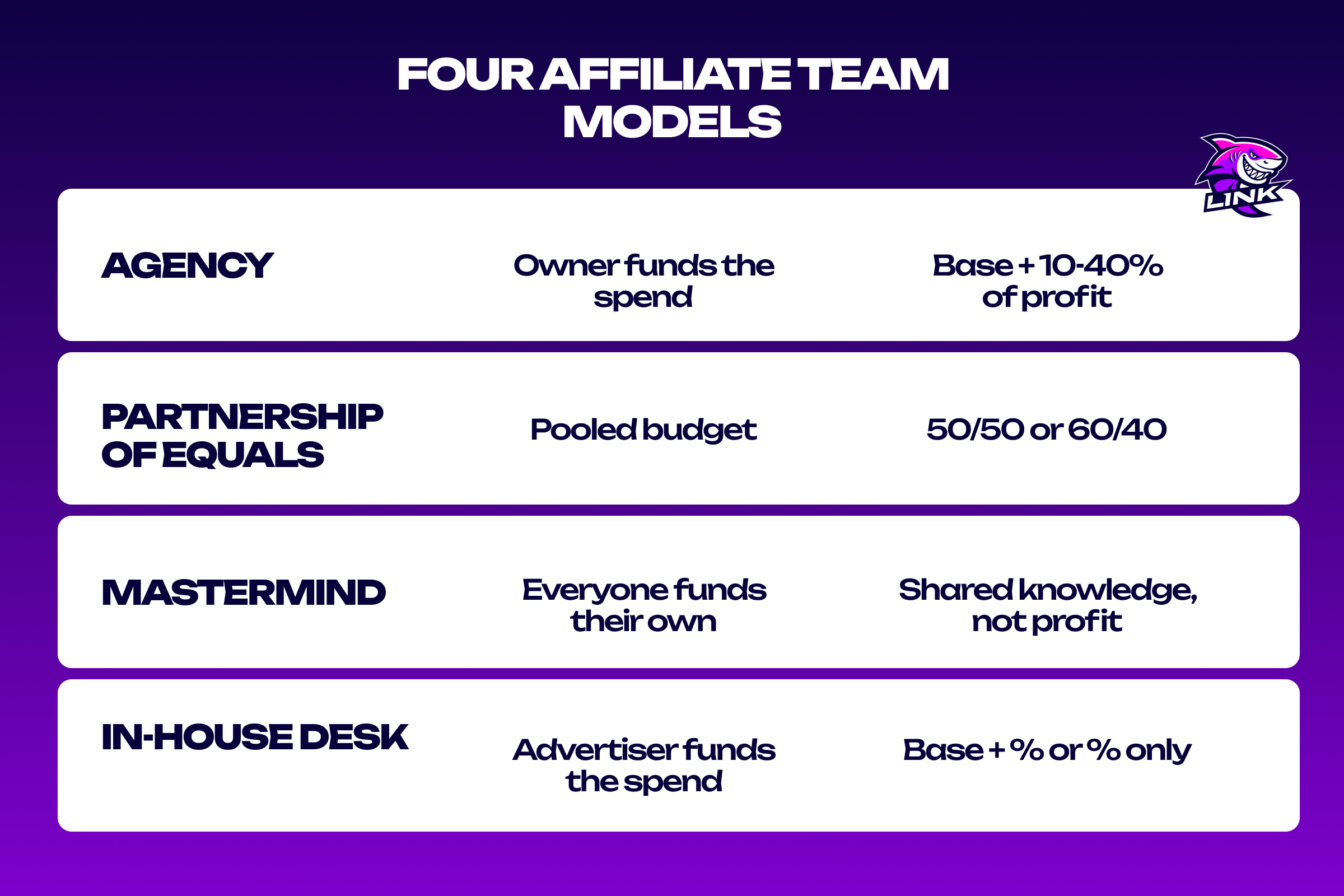
How people join forces varies more than any org chart suggests. Four arrangements dominate: an agency, a partnership of equals, a mastermind circle and an in-house desk sitting inside the advertiser.
Types of affiliate teams: from a pair to a holding
Headcount drives everything downstream: who gets paid how, whether a legal entity is needed, how fast a decision travels. Two people negotiate in a chat window. Fifty without written process stall inside a month.
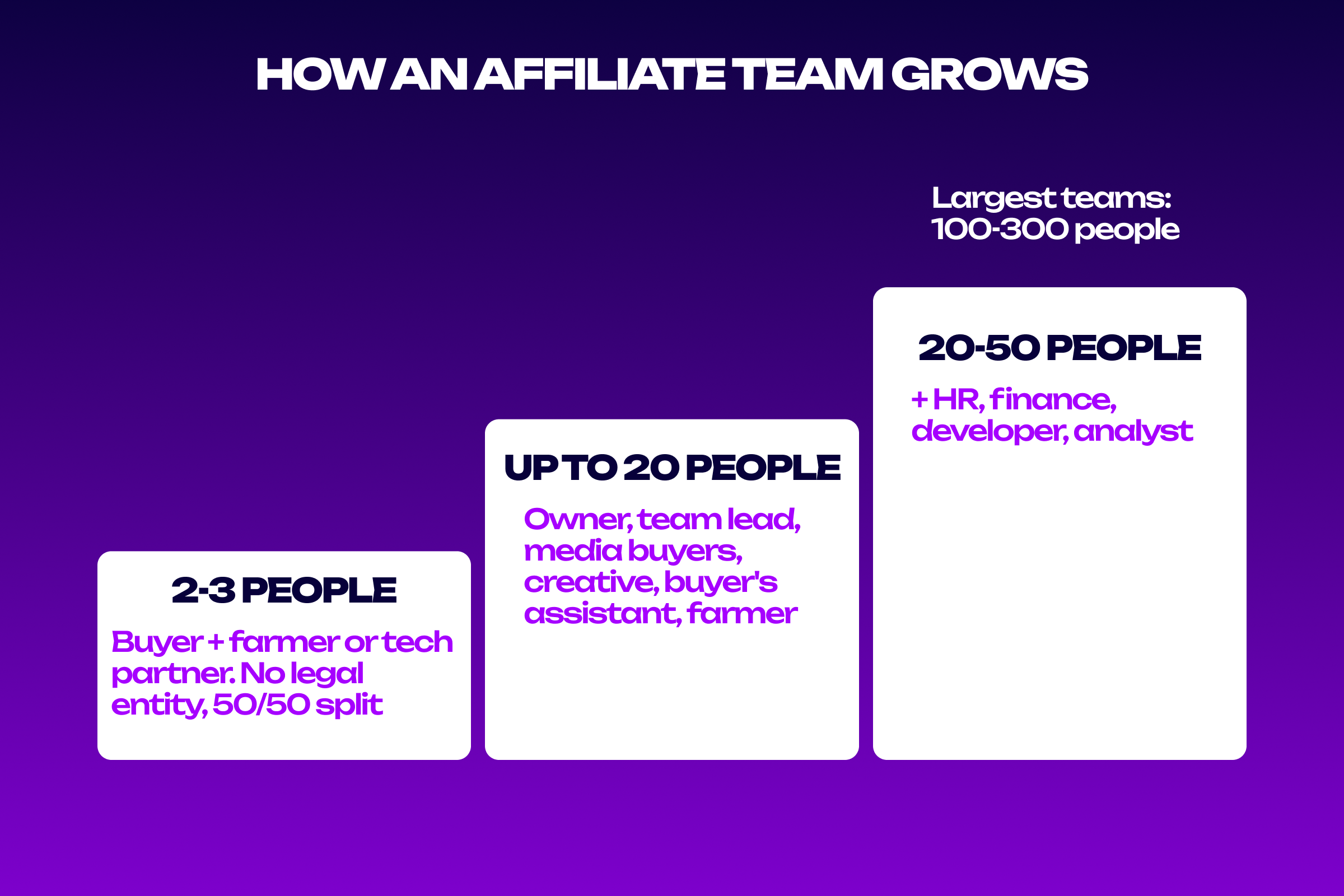
Stage one is a pair or a trio: a buyer with a technical partner, or a buyer with a farmer. No company, no contracts, profit split down the middle or 60 to 40. Stage two builds the vertical up to 20 heads: owner, team lead, media buyers, creative, buyer’s assistant, farmer.
Past 20 the nature of the thing changes. Between 20 and 50 staff you find HR, finance, in-house development and analytics, departments that never touch a campaign yet keep it running. The largest affiliate teams in gambling reach 100 to 300 people.
- A two or three person crew, typically one buyer plus a farmer or a technical partner. Nothing is registered anywhere, the split runs 50 to 50 or 60 to 40 depending on whose money funds the spend, and it rests on personal trust.
- A vertical of up to 20 people: owner, team lead, media buyers, creative, buyer’s assistant and farmer. Fixed rates appear here, with output quotas in accounts and a bonus grid, while the lead answers for department profit rather than one funnel.
- A structure of 20 to 50 where HR, a finance person, a developer and an analyst join the buyers. Overhead that produces no traffic grows fast, so this size pays off only when several verticals run at once and volume holds.
How affiliate teams share the money
Four splitting schemes cover almost every arrangement in the market, and the deciding factor is whose money funds the media buy. Risk the capital, keep the larger share.
| Model | Who funds the spend | How profit is split | Best fit |
|---|---|---|---|
| Agency | owner or investor | base rate plus 10-40% of own profit | newcomers with no capital |
| Partnership of equals | pooled by the members | 50 to 50 or 60 to 40 by contribution | two or three seasoned buyers |
| Mastermind | each member separately | nothing is split, only knowledge | solo buyers with their own turnover |
| In-house desk | the advertiser | base rate plus a percentage, or percentage only | anyone wanting a predictable payout |
A buyer’s percentage climbs with results rather than tenure. Five to ten percent of net profit is the floor; a working grid opens at 10% on the first 2000-5000 USD and tops out near 40% once turnover passes 45,000 USD. Advertised 50% deals are recruitment dressing.
Team leads are priced on different logic, since they answer for other people’s numbers. The common shape is 2500-4000 USD fixed plus 2-5% of department profit. Farmers sit at 250-800 USD against a quota of 100-300 accounts, each needing 7 to 21 days of warming.
Subtract the running costs before celebrating any split. Proxies, an antidetect browser, accounts and a tracker for attribution cost a small crew 300-800 USD a month, and losing months come out of the same pot.
GEO and localisation: where affiliate teams sit
Two geographies matter here and they rarely overlap: where the desks physically sit, and the market the traffic goes to. Public directories put Ukraine first on desk count: roughly 20 of 59 entries in one catalogue, 28 of 103 in another.
Kazakhstan follows with Almaty and Astana, then Poland, Cyprus, the UAE, Belarus and Georgia. Gambling and betting account for 41% to 60% of those listings depending on the directory. Fully remote setups stay common below five people.
| Region | Why crews go there | The catch |
|---|---|---|
| Ukraine and Poland | deepest pool of buyers and farmers | fierce competition, rates climb fast |
| Kazakhstan and Central Asia | cheaper offices, lower pay expectations | few strong team leads, you grow your own |
| Cyprus | practical jurisdiction for the legal entity | 15% corporate tax from 2026 plus annual audit |
| UAE | meeting point with advertisers | rent is steep, relocating everyone rarely pays |
| Fully remote | zero office cost, hire from anywhere | discipline slips past 10-15 people |
Traffic GEO gets picked against the wallet, not the map. Tier-1 pays 200-400 USD per deposit yet wants 10,000 USD and a compliance-ready setup first. Tier-3 pays 15-50 USD per player and validates a funnel on 300 USD, which is why small affiliate teams cut their teeth there.
Paperwork, contracts and internal security
Nobody registers a company for a duo: a wallet address and a split after the payout will do. The picture shifts around the fifth hire, when payroll turns regular and other people’s money sits on your balance, and that is when a team incorporates abroad. Cyprus moved corporate tax from 12.5% to 15% on 1 January 2026.
Employment records barely exist in this niche; a contractor agreement, an NDA and a clause banning private traffic on the side do. Money is the easy part, and the clauses that matter cover ownership of creatives, accounts and funnels after an exit.
Internal security carries as much weight as the paperwork. Separate credentials per buyer, no shared super-admin, password rotation on exit. Funnel theft is common enough that some larger teams run candidates through a polygraph.
Building an affiliate team from scratch
Hiring is the second step, never the first. Until one funnel reliably prints profit, extra people only speed up the burn. Budget 10,000 to 15,000 USD for launch, and most of it goes on media and consumables rather than salaries: 2000-3000 USD for tests, 200-300 USD of tooling per buyer.
Your first hire should remove whatever eats the most hours of your week, usually a farmer or a creative. Sourcing runs through industry job listings for affiliates rather than friends of friends. A second buyer waits until the first is steadily in the black.
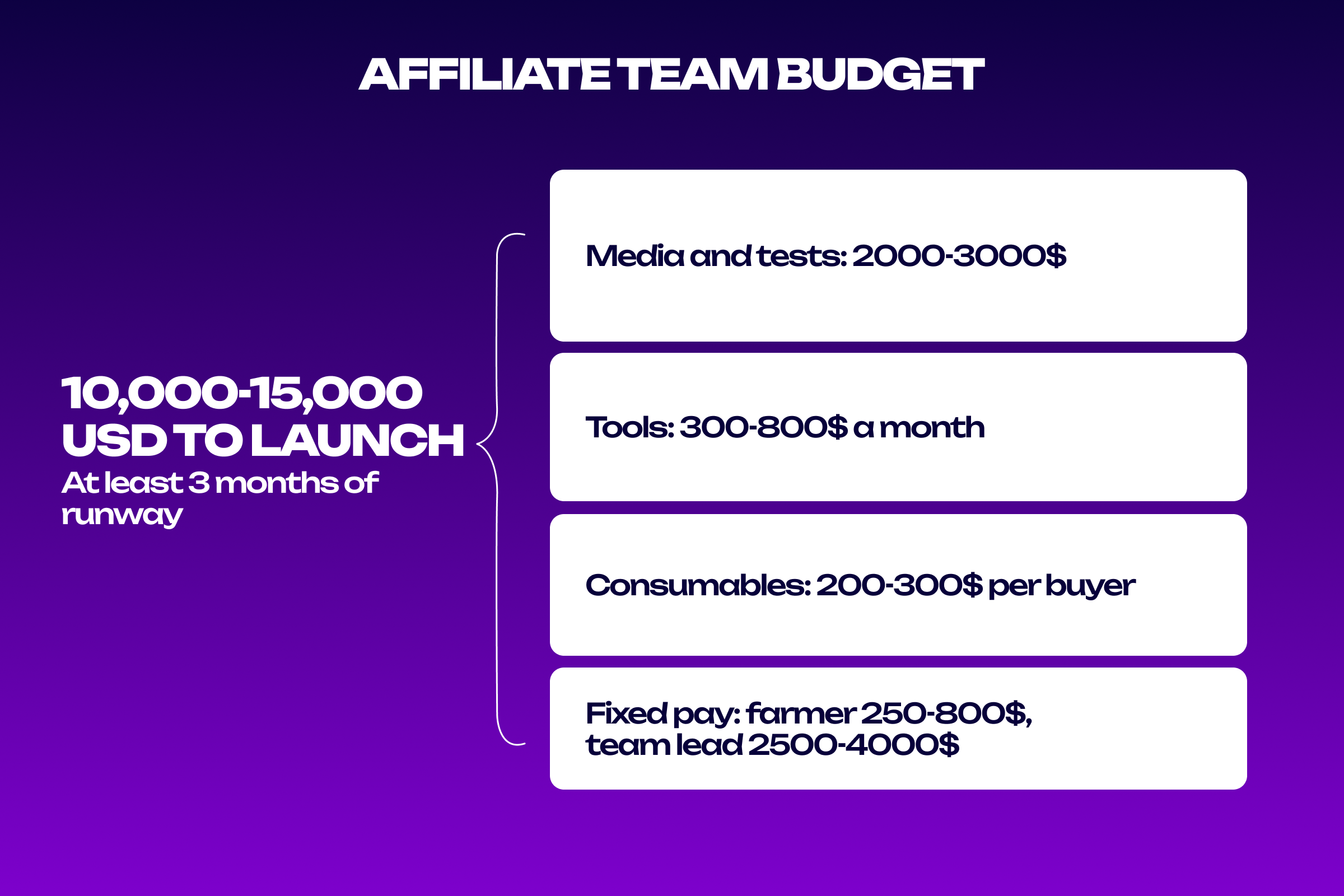
- Count runway before headcount. The 10,000-15,000 USD you start with should cover three months at minimum, because a first funnel rarely turns profitable faster, and the media reserve has to sit apart from the payroll pot.
- Hire against a written quota. For a farmer that reads 100-300 accounts a month at 250-800 USD; for an assistant it is campaigns launched and landers built. Agree the number before the first working day, not after.
- Build motivation in steps. A flat salary kills the appetite for testing, while pure commission scares off strong candidates during a losing month, so pair a modest base with 10-40% of net profit that moves with turnover.
- Set up reporting while the team is still under four people. Shared funnel statistics, individual logins and weekly reconciliation against the advertiser’s dashboard remove most arguments about whose traffic brought which deposits.
Mistakes that surface when scaling
Failure patterns repeat with almost no variation, and they trace back to hiring faster than process gets written. Money does not vanish in one bad week; it leaks quietly through duplicated work.
- Hiring five juniors at once instead of one. The test budget disappears across five accounts, nobody senior reviews the work, and the team lead who would have caught it is not hired yet. Prove the funnel with one person first.
- Ignoring the 10 to 15 person threshold. Past that mark a group chat stops working as coordination, tasks duplicate and profit flattens while payroll grows. The fix is an operations manager and written process, not another buyer.
- A base with no ladder, or a ladder with no base. Flat pay removes any reason to test new angles, pure commission pushes a buyer out after one losing month, and the working answer combines both and recalculates on turnover.
- One admin login shared by everyone. A departing buyer walks off with accounts, creatives and live funnels, and without a signed agreement there is nothing to enforce. Separated permissions cost far less than one such incident.
A team rarely dies from running out of money. It dies when two people do the same job and both believe it belongs to them, and a two-page process document saves more budget than another hire.
FAQ
The same five questions about affiliate teams come up every month, so here they are with short answers.
How is an affiliate team different from a solo buyer?
Division of labour and the size of the pot. A solo operator runs 200-300 USD a day and handles creatives, farming and analytics alone, whereas a team splits those across people and holds several verticals at once.
What does it cost to build an affiliate team?
Plan on 10,000 to 15,000 USD for a cold start. That covers test media, 200-300 USD of consumables per buyer, 300-800 USD of monthly tooling and the fixed pay of the first hires. An office is optional and most small crews skip it.
How many people do you need at the start?
Two is enough: a buyer plus a farmer, or a buyer plus a technical partner. No legal entity is required, the split runs 50 to 50 or 60 to 40, and no team lead is needed yet. A third seat opens when those two hit their launch ceiling.
How do media buyers get paid inside a team?
A base rate plus a share of net profit. The floor sits at 5-10%, the grid opens at 10% on the first few thousand dollars and reaches 40% above 45,000 USD of turnover. A lead takes 2500-4000 USD fixed plus 2-5% of department profit.
Are contracts and a legal entity necessary?
Not for two people, yes from about five. The minimum set is a contractor agreement, an NDA and written ownership of accounts and funnels. Incorporation follows regular payroll, and Cyprus at 15% corporate tax stays a common choice.
The takeaway
An affiliate team buys speed by taking five jobs off one pair of hands. A duo delivers the first lift at almost no cost, a vertical of 20 needs a team lead and written quotas, and anything from 20 to 50 survives on HR, finance and analytics.
Price the structure, not the headcount: 10,000-15,000 USD to launch, 300-800 USD monthly on tools, base pay plus 10% to 40% commission. Match the model to whoever funds the media, and sign the paperwork before the first joint campaign.